
You might think bigger gain always fixes dead zones, but that’s not the full truth. If you’re tired of dropped calls and slow streaming, you’ll want a booster that matches your outdoor signal, carrier bands, and home layout. I’ll walk you through top 2026 picks that cover 2,000 to 5,000 square feet, handle DSS 5G and LTE bands, offer self‑oscillation protection and easy tuning, and fit different budgets and installation skills so you can pick the right fit.
| HiBoost 5G/4G LTE Cell Signal Booster for Home |
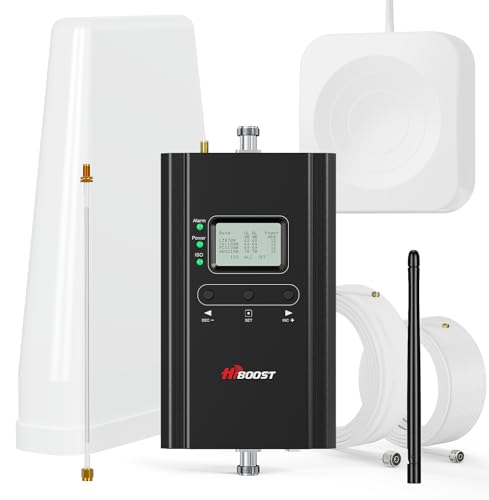
| Best for Large Homes | Carrier Compatibility: All U.S. & Canadian carriers (AT&T, Verizon, T-Mobile, Straight Talk, U.S. Cellular) | 5G/4G Support: 4G LTE and 5G where deployed within existing 4G bands (DSS); not mmWave | Requires Outdoor Signal: Needs at least 1–2 bars outdoor signal to operate effectively | VIEW LATEST PRICE | Read Our Analysis |
| Cell Phone Signal Booster for Verizon & AT&T 5G/4G |

| Carrier-Specific Power | Carrier Compatibility: Designed for Verizon & AT&T | 5G/4G Support: 4G LTE and 5G within LTE bands | Requires Outdoor Signal: Requires at least 1–2 bars outdoor signal for best performance | VIEW LATEST PRICE | Read Our Analysis |
| Cell Phone Signal Booster for All U.S. Carriers |

| Compact High-Gain | Carrier Compatibility: All U.S. carriers (Verizon, AT&T, T-Mobile, U.S. Cellular, others) | 5G/4G Support: 4G LTE and 5G (requires carrier 5G on existing 4G bands) | Requires Outdoor Signal: Requires at least 1–2 bars of outdoor signal to function effectively | VIEW LATEST PRICE | Read Our Analysis |
| Home Office 5G/4G LTE Cell Phone Signal Booster |

| Home Office Ready | Carrier Compatibility: All U.S. carriers (Verizon, AT&T, T-Mobile, Sprint, Straight Talk, U.S. Cellular) | 5G/4G Support: 4G LTE and 5G compatible | Requires Outdoor Signal: Requires outdoor signal (implied; optimal placement monitored via app/LCD) | VIEW LATEST PRICE | Read Our Analysis |
| Cell Phone Signal Booster for Verizon & AT&T |

| Directional Performance | Carrier Compatibility: Designed for Verizon & AT&T | 5G/4G Support: 4G LTE and 5G via DSS on specified bands | Requires Outdoor Signal: Requires outdoor signal (implied for directional antenna/boosting) | VIEW LATEST PRICE | Read Our Analysis |
More Details on Our Top Picks
HiBoost 5G/4G LTE Cell Signal Booster for Home
If you live in a small to medium home or run a shop and want steady calls, texts, and video streaming without fuss, the HiBoost 5G/4G LTE Cell Signal Booster for Home is a strong choice. You’ll get coverage for about 4,000 sq ft, ideal for two to three rooms, offices, shops, and metal buildings. It helps talk, text, and streaming for many users at once, but needs one to two bars outside to work well. You’ll use the app and LCD to fine tune, watch signal, and follow videos. It supports major US and Canadian carriers and meets FCC rules.
- Carrier Compatibility:All U.S. & Canadian carriers (AT&T, Verizon, T-Mobile, Straight Talk, U.S. Cellular)
- 5G/4G Support:4G LTE and 5G where deployed within existing 4G bands (DSS); not mmWave
- Requires Outdoor Signal:Needs at least 1–2 bars outdoor signal to operate effectively
- FCC Certification / Compliance:FCC approved; meets applicable safety standards
- Automatic Gain Control (AGC):High-performance smart chip AGC for stable performance
- Warranty / Support & Return Policy:App support, documentation; FCC compliance (warranty not explicitly stated)
- Additional Feature:HiBoost app fine-tuning
- Additional Feature:LCD signal display
- Additional Feature:Window no-drill cable
Cell Phone Signal Booster for Verizon & AT&T 5G/4G
You’ll want this high gain booster if you live in a larger home, basement, metal-roof house, small office, or a rural area where Verizon or AT&T signal drops make calls and streaming frustrating. You’ll get support for Verizon and AT&T bands 12, 13, and 17 at 700 MHz, plus 5G within LTE bands and 4G LTE. It boosts voice, speeds, and reliability for many users and covers up to 5,000 sq ft. You need 1–2 bars outside. It has 65 dB AGC, self-oscillation protection, LED status, standby power save, FCC approval, easy 30-minute install, plus strong warranty and support.
- Carrier Compatibility:Designed for Verizon & AT&T
- 5G/4G Support:4G LTE and 5G within LTE bands
- Requires Outdoor Signal:Requires at least 1–2 bars outdoor signal for best performance
- FCC Certification / Compliance:FCC approved for residential use
- Automatic Gain Control (AGC):AGC with 65 dB max gain; self-oscillation protection
- Warranty / Support & Return Policy:30-day money-back, 3-year warranty, lifetime technical support
- Additional Feature:65 dB maximum gain
- Additional Feature:Standby low-power mode
- Additional Feature:3-year warranty
Cell Phone Signal Booster for All U.S. Carriers
For anyone struggling with weak bars at home or in a small workplace, this high gain booster is your best choice because it supports every major U.S. carrier and works on the exact bands those networks use, so you won’t need separate gear for different phones. You’ll get 72 dB gain and up to 2,000 sq ft coverage when outdoor signal is decent. It boosts 3G, 4G LTE, and 5G where available. Installation is simple with a compact whip antenna and clear ZORIDA app support. FCC certified, lifetime U.S. tech help, 30-day return, and three-year warranty give peace of mind.
- Carrier Compatibility:All U.S. carriers (Verizon, AT&T, T-Mobile, U.S. Cellular, others)
- 5G/4G Support:4G LTE and 5G (requires carrier 5G on existing 4G bands)
- Requires Outdoor Signal:Requires at least 1–2 bars of outdoor signal to function effectively
- FCC Certification / Compliance:FCC and IC certified
- Automatic Gain Control (AGC):Maximum gain 72 dB (includes automatic gain behavior noted) / gain conservation benefit
- Warranty / Support & Return Policy:30-day money-back, 3-year warranty, lifetime U.S.-based tech support via app/chat/phone/email
- Additional Feature:72 dB maximum gain
- Additional Feature:Compact whip indoor antenna
- Additional Feature:ZORIDA app support
Home Office 5G/4G LTE Cell Phone Signal Booster
When you work from home and need rock-solid calls, the Home Office 5G/4G LTE Cell Phone Signal Booster is built to rescue your productivity and peace of mind. You’ll cover up to 2000 sq. ft. and use any U.S. carrier without extra fees. The outside directional antenna pulls distant signals with higher gain so you get fewer dropped calls and faster uploads and downloads. AGC keeps noise low while the LCD and Signal Supervisor app help you aim the antenna for best results. Installation is simple, support is local, FCC certified, and you get a 30-day return plus three-year warranty.
- Carrier Compatibility:All U.S. carriers (Verizon, AT&T, T-Mobile, Sprint, Straight Talk, U.S. Cellular)
- 5G/4G Support:4G LTE and 5G compatible
- Requires Outdoor Signal:Requires outdoor signal (implied; optimal placement monitored via app/LCD)
- FCC Certification / Compliance:FCC certified; meets FCC guidelines
- Automatic Gain Control (AGC):AGC for low-noise, self-adjusting performance
- Warranty / Support & Return Policy:30-day money-back, 3-year warranty, U.S. local customer support
- Additional Feature:High-power directional antenna
- Additional Feature:Color LCD placement guide
- Additional Feature:HiBoost Signal Supervisor
Cell Phone Signal Booster for Verizon & AT&T
If you live in a home where Verizon or AT&T signal drops in rooms away from windows, this high gain phone signal booster is the best choice to bring reliable calls and faster data back into your daily life. You’ll get stronger 4G LTE and 5G where carriers use Dynamic Spectrum Sharing on bands 12, 13, 17, provided you have a 5G phone and carrier support. The 65 dB dual-band repeater and high-gain directional antenna aim at the nearest tower for up to 4,500 sq ft coverage. AGC adjusts gain, LEDs show status, and installation is DIY. FCC certified, with generous support and warranty.
- Carrier Compatibility:Designed for Verizon & AT&T
- 5G/4G Support:4G LTE and 5G via DSS on specified bands
- Requires Outdoor Signal:Requires outdoor signal (implied for directional antenna/boosting)
- FCC Certification / Compliance:FCC certified
- Automatic Gain Control (AGC):AGC detects existing signal strength and adjusts gain
- Warranty / Support & Return Policy:30-day money-back, 3-month replacement/up to 3-year repair, lifetime professional technical support
- Additional Feature:Dual-band 65 dB repeater
- Additional Feature:High-gain directional antenna
- Additional Feature:DIY installation
Factors to Consider When Choosing High Gain Phone Signal Boosters
When you pick a high gain phone signal booster, start by matching signal strength needs with the right gain so you don’t buy something that still leaves dead spots. Think about your coverage area size and the antenna type choice, since a larger space often needs external antennas and different placement to work well. Also check carrier and band support plus installation and placement requirements so the system actually connects to Verizon or AT&T and fits your home or office layout.
Signal Strength Needs
Because signal needs vary so much by building and use, you’ll want to measure both outdoor and indoor strength before you pick a booster. Start by checking bars or dBm values. You should have at least 1–2 bars outside about -100 to -90 dBm for a booster to help. If outdoor readings are weak, choose higher maximum gain like 60 to 72 dB so the system amplifies faint signals more effectively. Think about how many people stream or make video calls. Higher signal lowers dropped connections and keeps speeds steady under load. Also check distance and obstructions to the nearest cell tower. Long runs or metal and concrete need stronger outdoor antennas and careful placement to reach indoor targets around -85 to -65 dBm for reliable service.
Coverage Area Size
Start by measuring the space you need to cover and picture how people will use their phones there, since coverage area isn’t just square footage, it’s how and where devices actually live. Measure rooms and total square feet, then map where calls, streaming, and work happen. Use stated coverage as a best case and plan for 25 to 50 percent less in dense walls or far-from-tower locations. Match booster gain and antenna type to reach farther rooms; a directional outdoor antenna plus higher gain helps extend service. For multi-room or multi-floor areas, plan multiple indoor antennas or splitters and consider cable runs and antenna separation limits. Think about placement carefully because poor installation shrinks real coverage quickly.
Carrier And Band Support
A clear match between your booster and your carrier’s frequency bands matters more than most people realize, so start by checking the exact bands your phone uses and pick a booster that lists those frequencies. You want a booster that supports 700 MHz band 12/13/17, 800–850 MHz band 5, 1700–2100 MHz band 4, 1900 MHz band 2/25, and any carrier-deployed 5G on existing LTE bands. Also confirm multi-carrier support if you need several providers boosted at once, since some units only handle a few bands. Check whether 5G support uses DSS within LTE bands versus mmWave, as most home boosters skip mmWave. Match the device gain and band coverage to your weakest outdoor frequencies. Finally verify FCC or IC certification so the booster won’t interfere with licensed networks.
Antenna Type Choice
When you’re choosing an antenna for a high gain phone signal booster, pick the type that matches your outdoor signal situation and indoor needs so you won’t waste time or money. If your outdoor signal comes from one distant tower, a directional Yagi or high-gain panel delivers stronger reception and longer range, but you’ll need to aim it. If towers surround you, an omnidirectional antenna gathers signals from all directions and is simpler to use, though it usually gives less reach. For longer reach choose higher dBi ratings, since roughly every 3 dBi doubles effective power in the antenna’s favored direction. Inside, use ceiling dome antennas for even multi-room coverage or whip antennas for a single room. Also use short, low-loss coax and matching N-type connectors to keep gains real.
Installation And Placement
Think about placement like tuning a musical instrument: small moves make big differences, and you want everything in harmony. Place the outdoor antenna as high as you can and point it toward the nearest cell tower. Even small shifts in height or direction can turn weak bars into usable indoor signals. Keep 20 to 30 feet or a full interior wall between the outdoor and indoor antennas to avoid oscillation. Mount the indoor unit centrally in the area you use most, up high and away from metal, microwaves, and routers. Choose directional outdoor antennas for long range and omni for short, multi directional needs, and keep coax runs short to reduce loss. Test with an app or meter, tweak aim and position, and watch LEDs or AGC for stable gain without interference.
Warranty And Compliance
You’ve just dialed in your antenna placement and noticed a real improvement, so now let’s make sure your booster stays legal and supported for the long run. First, confirm FCC certification or your country’s regulator approval. That protects carriers and keeps you on the right side of the law. Next, check warranty length and scope. Look for at least a 30-day return and a one to three year manufacturer warranty that covers parts and failures. Dig into what’s covered such as power supplies, antennas, and labor, and whether DIY installation affects coverage. Also verify tech support channels and whether they’re free or need registration. Finally, review out of warranty options and claim steps like proof of purchase and serial registration to avoid surprises.