
If you want a practical laptop with Intel UHD Graphics in 2026, you’ll want one that balances battery life, thermals, and everyday performance. I’ll guide you through five strong options-from roomy 16″ screens to budget-friendly 14″ models-so you can match features like RAM, storage, and ports to your needs. Keep going to see which model fits your workflow and budget.
| Dell Inspiron 16 5640 Laptop – 16″ FHD+ 16GB 1TB |

| Best for Productivity | Processor Family: Intel Core (7-150U) | Integrated Graphics: Intel integrated graphics (Intel UHD family) | RAM: 16 GB DDR5 | CHECK LATEST PRICE | Read Our Analysis |
| HP 2025 Student Laptop Intel N150 14″ Rose Gold |
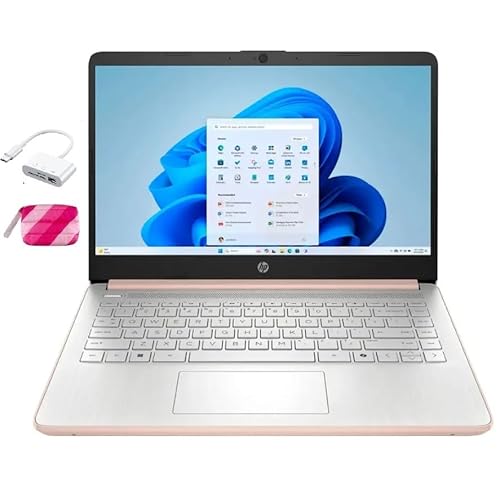
| Student Budget Pick | Processor Family: Intel Processor (N150) | Integrated Graphics: Integrated Intel Graphics (Intel UHD family) | RAM: 4 GB (configurable up to 16 GB DDR4) | CHECK LATEST PRICE | Read Our Analysis |
| ASUS Vivobook 16 Laptop i7-13620H 16GB 512GB |

| Performance Champion | Processor Family: Intel Core (i7-13620H) | Integrated Graphics: Intel UHD Graphics (integrated) | RAM: 16 GB | CHECK LATEST PRICE | Read Our Analysis |
| Lenovo IdeaPad 1 14 Laptop Celeron N4020 |

| Ultra-Portable Budget | Processor Family: Intel Celeron (N4020) | Integrated Graphics: Intel UHD Graphics 600 (integrated) | RAM: 4 GB DDR4 | CHECK LATEST PRICE | Read Our Analysis |
| ASUS 14″ FHD Laptop Pentium N6000 (Renewed) |

| Affordable Everyday Option | Processor Family: Intel Pentium Silver (N6000) | Integrated Graphics: Intel UHD Graphics (integrated) | RAM: 4 GB DDR4 | CHECK LATEST PRICE | Read Our Analysis |
More Details on Our Top Picks
Dell Inspiron 16 5640 Laptop – 16″ FHD+ 16GB 1TB
If you need a roomy, work-ready laptop that handles everyday multitasking and light creative work without a discrete GPU, the Dell Inspiron 16 5640 is a strong choice – its 16:10 FHD+ display and Intel Core 7-150U with Intel UHD graphics give you smooth productivity, 16GB of DDR5 memory, and a 1TB SSD for plenty of storage and responsiveness. You’ll appreciate the wider viewing area, optional touchscreen, and up-to-2.5K support for clearer visuals. Built with recycled materials and a durable Midnight Blue finish, it adds security with TPM and a mechanical camera shutter, plus solid audio, camera upgrades, and ENERGY STAR/EPEAT credentials.
- Processor Family:Intel Core (7-150U)
- Integrated Graphics:Intel integrated graphics (Intel UHD family)
- RAM:16 GB DDR5
- Display Size & Aspect:16.0″ 16:10 FHD+ (1920 x 1200) (option for touchscreen / up to 2.5K)
- Storage Type & Capacity:1 TB SSD
- Operating System / Software Bundle:(Implied Windows – Dell services) with 1 Year Onsite Service, Dell Migrate tool (6 months)
- Additional Feature:Mechanical camera privacy shutter
- Additional Feature:ENERGY STAR & EPEAT
- Additional Feature:Post-consumer recycled plastics
HP 2025 Student Laptop Intel N150 14″ Rose Gold
Students and budget-conscious users will appreciate the HP 2025 Student Laptop’s blend of portability and practicality: its 14-inch anti-glare display, long battery life, and Intel N150 with integrated Intel UHD graphics deliver smooth everyday performance for note-taking, streaming, and light creative work. You’ll get a quad-core N150 (up to 3.6 GHz, 6 MB cache) paired with 4 GB RAM and 128 GB flash storage, upgradeable to 16 GB. The micro-edge HD screen (1366×768, 250 nits) and 720p True Vision webcam suit classes and video calls. Ports include USB-C, USB-A, HDMI, SD, plus Wi‑Fi 6, Bluetooth, Windows 11, and one year of Microsoft 365 with Copilot.
- Processor Family:Intel Processor (N150)
- Integrated Graphics:Integrated Intel Graphics (Intel UHD family)
- RAM:4 GB (configurable up to 16 GB DDR4)
- Display Size & Aspect:14″ HD (1366 x 768), micro-edge, anti-glare
- Storage Type & Capacity:128 GB flash storage
- Operating System / Software Bundle:Windows 11 Home + 1 year Microsoft 365 with Microsoft Copilot
- Additional Feature:1 year Office 365
- Additional Feature:Wi-Fi 6 connectivity
- Additional Feature:Micro-edge anti-glare display
ASUS Vivobook 16 Laptop i7-13620H 16GB 512GB
Built for creators and multitaskers who need a large, color-accurate screen without a premium GPU, the ASUS Vivobook 16 pairs a 16-inch WUXGA 16:10 display with an Intel Core i7-13620H and Intel UHD Graphics to handle everyday content creation, multitasking, and media work smoothly. You get 16 GB RAM and a 512 GB PCIe 4.0 SSD, plus Windows 11 for responsive performance. The 300-nit panel offers life-like colors at 60 Hz, ideal for editing and streaming. Microsoft Copilot assists with summaries, image generation, and automation. It’s a solid, versatile choice when you need power without discrete graphics.
- Processor Family:Intel Core (i7-13620H)
- Integrated Graphics:Intel UHD Graphics (integrated)
- RAM:16 GB
- Display Size & Aspect:16″ WUXGA (1920 x 1200), 16:10
- Storage Type & Capacity:512 GB PCIe 4.0 SSD
- Operating System / Software Bundle:Windows 11 + Microsoft Copilot features
- Additional Feature:300-nit brightness display
- Additional Feature:Microsoft Copilot integration
- Additional Feature:PCIe 4.0 SSD
Lenovo IdeaPad 1 14 Laptop Celeron N4020
Choose the Lenovo IdeaPad 1 14 if you want an ultra-affordable, lightweight Chromebook-style laptop for basic web browsing, streaming, and document work-its Intel Celeron N4020 with Intel UHD Graphics 600 and a 14″ HD display keep everyday tasks smooth while staying under 3 lbs. You’ll get 4GB DDR4 and 128GB total storage (64GB eMMC plus 64GB via microSD), Windows 11 in S Mode, narrow bezels for a modern look, and Dolby Audio through dual stereo speakers. Ports include two USB-A, HDMI, microSD, and a headset jack, while Wi‑Fi 802.11ac and Bluetooth 4.1 handle connectivity.
- Processor Family:Intel Celeron (N4020)
- Integrated Graphics:Intel UHD Graphics 600 (integrated)
- RAM:4 GB DDR4
- Display Size & Aspect:14″ HD (narrow bezels)
- Storage Type & Capacity:128 GB total (64 GB eMMC + 64 GB microSD)
- Operating System / Software Bundle:Windows 11 in S Mode
- Additional Feature:Lightweight under 3 lbs
- Additional Feature:Windows 11 S Mode
- Additional Feature:Dolby Audio speakers
ASUS 14″ FHD Laptop Pentium N6000 (Renewed)
If you need an affordable, ultraportable laptop for web browsing, streaming, and basic productivity, the renewed ASUS 14″ with the Pentium N6000 and Intel UHD Graphics fits the bill. You get a 14″ FHD IPS display with sharp details and crisp colors, plus Windows 11 ready to go. Performance suits light tasks thanks to the N6000, 4GB DDR4 RAM, and 64GB eMMC storage; don’t expect heavy multitasking. Connectivity is solid: Wi‑Fi 5, Bluetooth 5.1, USB-A 2.0, USB-A 3.2, USB-C 3.2, HDMI 1.4, and an SD reader. It’s lightweight (2.87 lbs) and compact for travel.
- Processor Family:Intel Pentium Silver (N6000)
- Integrated Graphics:Intel UHD Graphics (integrated)
- RAM:4 GB DDR4
- Display Size & Aspect:14″ FHD IPS (1920 x 1080)
- Storage Type & Capacity:64 GB eMMC (renewed)
- Operating System / Software Bundle:Windows 11 (renewed unit)
- Additional Feature:Renewed Star Black finish
- Additional Feature:USB-C 3.2 port
- Additional Feature:720p HD webcam
Factors to Consider When Choosing Intel UHD Graphics Laptops
When choosing an Intel UHD Graphics laptop, consider what performance fits your workloads-basic web tasks, light photo editing, or casual gaming. Check display quality and resolution, plus match memory and storage to your multitasking and file needs. Also weigh battery life and portability against thermal management and cooling for sustained use.
Performance And Workloads
Although Intel UHD Graphics are convenient for everyday use, you’ll need to weigh several hardware and workload factors to get the experience you want. Because UHD is integrated and shares system RAM, total memory and its speed-DDR4 vs DDR5, single- vs dual-channel-directly affect performance. These GPUs handle browsing, video playback (including 1080p and some HEVC 4K), and basic photo edits smoothly, but modern AAA gaming at native settings will struggle. For light creative work like 2D design and basic video edits, pair a high‑clock CPU with 8–16 GB RAM; more demanding projects will hit GPU and VRAM limits. Also consider thermal headroom and sustained boost behavior: throttling cuts integrated GPU clocks. Finally, choose newer CPU generations for noticeably better GPU compute and frame rates.
Display Quality And Resolution
Screen quality matters more than raw GPU power for Intel UHD Graphics laptops, since the display largely determines perceived sharpness and color fidelity. You should prioritize higher native resolutions (1920×1200, 1920×1080 or above) for crisper text and more workspace; UHD Graphics rely on the panel to convey clarity. Prefer 16:10 or taller aspect ratios to gain vertical space without wider bezels, which helps productivity and browsing.
Also check brightness-aim for 250–300 nits or more so content stays readable indoors and outdoors, because integrated GPUs won’t overcome glare. Choose IPS or equivalent panels with strong sRGB coverage for consistent viewing angles and accurate colors. Finally, 60 Hz is fine for most tasks; only opt for higher refresh rates if you accept extra GPU load and reduced battery life.
Memory And Storage Needs
Good display hardware needs matching system resources, so don’t overlook memory and storage when choosing an Intel UHD Graphics laptop. For smooth multitasking, aim for 8–16 GB of RAM; integrated GPUs share system memory, so more RAM improves graphics buffering and responsiveness. Prefer dual-channel configurations (two matched modules) to double memory bandwidth versus single-channel setups.
Choose faster RAM (DDR4/DDR5 at higher MHz) when possible, since higher memory bandwidth measurably boosts integrated GPU performance for gaming and media tasks. For storage, pick an SSD (NVMe preferred) with at least 256 GB to make sure quick OS and app load times. If you do creative work or keep large media libraries, prioritize 512 GB–1 TB SSDs or pair a fast boot SSD with secondary storage to avoid performance drops from near-full drives.
Battery Life And Portability
Often you’ll get noticeably better battery life with Intel UHD Graphics than with discrete GPUs. That efficiency often translates to 8–12+ hours in ultraportables under light use, but real-world endurance hinges on CPU efficiency and screen specs. Higher-resolution or brighter displays (>1080p or >300 nits) can cut runtime 20–40%. Thin-and-light models usually pair low-voltage CPUs and smaller batteries, so you’ll trade weight (<3.5 lbs) for mixed-use runtimes around 6–10 hours. Tweak power profiles, keep drivers updated, and limit background tasks to gain several hours of extra life. If you need both mobility and long unplugged use, prioritize laptops with 50–70 Wh batteries and fast-charging support to minimize downtime and keep you productive on the go.
Thermal Management And Cooling
When you’re comparing Intel UHD-equipped laptops, pay close attention to how the system manages heat under sustained workloads, because thin designs with low-TDP CPUs can throttle graphics performance quickly. Verify the laptop’s TDP handling and expected sustained CPU/GPU clocks; lower TDP in slim chassis often causes frequency drops. Prefer multi-heatpipe arrays or copper vapor chambers over single-sheet cooling for better dissipation and reduced throttling. Check reported chassis surface temps and CPU/GPU junction readings-values above ~90°C usually trigger frequency capping. Look for larger intake/exhaust vents and fans with higher max RPM, but balance measured fan noise (dB) against cooling gains. Also consider chassis materials and hinge/vent layouts; metal lids and elevated designs aid passive heat spread and steadier UHD performance.
Connectivity And Expandability
Because you’ll likely connect multiple displays and peripherals, prioritize laptops with versatile ports and clear upgrade paths: at minimum get a USB‑C with DisplayPort Alt Mode or Thunderbolt, several USB‑A ports (USB 3.2 Gen 1+), and an HDMI or mini‑DP output for external monitors and docks. Also check for an SD or microSD reader for quick media transfers and an available M.2 slot so you can add or upgrade an SSD later. Confirm the chassis offers user‑accessible RAM and storage bays or clear manufacturer documentation on upgrades. Finally, verify networking specs – Wi‑Fi 6 or newer and Bluetooth 5.0+ – to make certain reliable wireless performance and low‑latency accessory pairing. These choices extend lifespan and flexibility.
Security And Build Quality
While choosing an Intel UHD graphics laptop, prioritize a rugged chassis and hardware security so your machine stays reliable and your data stays safe-look for MIL‑STD‑810G (or equivalent) certification, a TPM for encryption and authentication, and physical privacy controls like a camera shutter and mic‑mute switch. You should also check cooling design and build materials; sturdy aluminum or reinforced polycarbonate and efficient thermal layouts prevent thermal throttling that hurts integrated graphics performance. Verify TPM presence and on‑device encryption support to protect stored keys and credentials. Confirm physical privacy features to avoid unauthorized audio/video capture. Finally, review warranty terms, on‑site repair options, and any advertised longevity testing so you minimize downtime and guarantee the laptop’s durability matches your workload and mobility needs.