

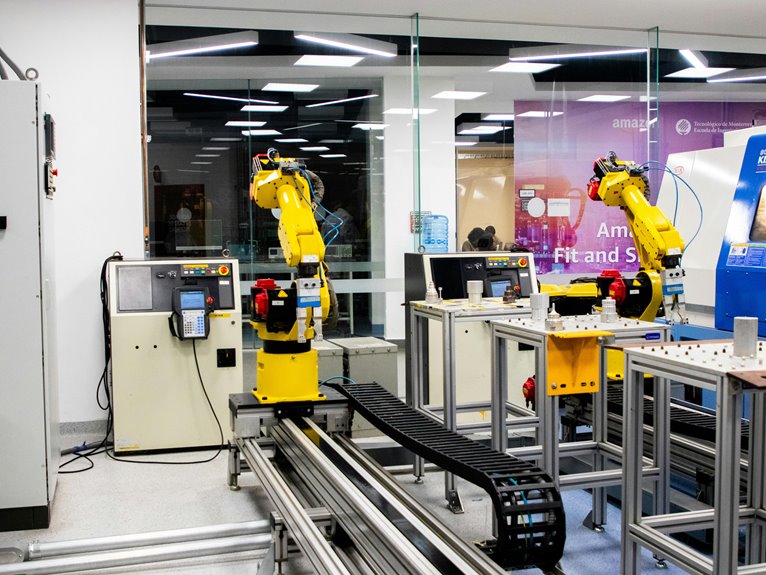
Like a watchmaker setting gears in motion, you see a robot work as sensors feed data to a controller, software chooses the next step, and actuators convert commands into force and movement. You can trace each cycle through feedback, timing, and safety checks, whether the robot is lifting parts, traversing a floor, or sorting goods. The mechanics are clear, but the real constraint emerges whenever precision meets changing conditions.
How Robots Work in Automation
Robots work in automation through sensing their environment, processing that data, and converting it into controlled mechanical action.
In your automation system overview, you trace how controllers interpret inputs, apply robot decision logic, and send commands to actuators.
You’ll see software coordinate timing, motion paths, and task rules so each cycle stays consistent.
Power supplies keep the system available, while mechanical assemblies turn instructions into precise movement.
Whenever you understand this flow, you can evaluate performance, diagnose faults, and improve throughput with confidence.
You’re part of a disciplined workflow where each component supports the next, so your team can build reliable, scalable automation that meets production targets without sacrificing accuracy or control.
Sensors That Guide Robot Actions
You use proximity and vision sensors to measure distance, detect object position, and map the robot’s workspace in real time.
You also use touch and force sensors to confirm contact, regulate gripping pressure, and prevent damage during manipulation.
Together, these sensors feed the controller with precise input so the robot can adjust actions accurately.
Proximity And Vision Sensors
Whenever you integrate cameras, infrared units, or lidar, your controller can classify parts, locate fixtures, and track motion with consistent precision. This sensor fusion supports smoother route planning, tighter pick-and-place cycles, and better alignment during assembly.
You’ll see stronger reliability whenever software filters noise and updates targets in real time. Together, these sensors help your team build robots that respond intelligently and fit shared workspaces.
Touch And Force Sensing
How do robots know whenever a surface, part, or human hand is resisting motion? You equip them with tactile sensing and force feedback. These sensors measure contact pressure, slip, and torque, then send signals to the controller, which adjusts speed, grip, and path in real time. In your automation cell, this keeps cobots safe and improves assembly accuracy.
| Signal | Action |
|---|---|
| Light contact | Slow motion |
| Rising force | Reduce grip |
| Slip detected | Reposition tool |
| Excess load | Stop and alert |
You can trust this loop whenever you need delicate handling, because it turns touch into measurable data. That shared control helps your team work with robots confidently, even on demanding tasks.
Programming Robot Workflows
You define task sequencing so each step happens in the right order, with clear conditions for branching, pausing, or recovery.
Through workflow scripting, you encode these rules in a format the controller can execute repeatedly and consistently.
You’ll want to map inputs, outputs, timing, and exception handling before deployment, because that structure reduces ambiguity and improves reliability.
Whenever you test each script, you verify that the robot responds to data the way your team expects.
That shared discipline helps you build systems that fit together cleanly, support collaborative operations, and stay adaptable as production needs change.
How Actuators Move Robots
You’ll see that actuators convert controller commands into physical motion using electric, hydraulic, or pneumatic energy.
You can classify them according to motion output, such as rotary, linear, or servo-driven systems, depending on the robot’s task requirements.
You’ll also need motion control to regulate speed, torque, position, and repeatability so the robot moves with precision.
Actuator Types
Because actuators convert control signals into physical motion, they’re the components that let robots actually move, grip, lift, rotate, and position tools with precision.
You’ll usually work with electric motors, servo mechanisms, pneumatic cylinders, and hydraulic units, each suited to a distinct load and environment.
Electric actuators give you fine positioning and efficient continuous operation, while servo mechanisms add feedback for repeatable placement.
Pneumatic cylinders deliver fast, simple linear motion for pick-and-place tasks, and hydraulic actuators supply high force whenever you need heavy payloads or compact power density.
Whenever you select an actuator type, you join a system built around speed, force, stroke, duty cycle, and maintenance demands.
The right choice helps your robot perform reliably, safely, and consistently in production.
Motion Control
Once you’ve selected the right actuator type, motion control determines how that actuator turns commands into accurate robot movement.
You feed the controller target positions, speeds, or torques, and it compares them with sensor feedback to correct error in real time.
That closed loop tuning lets you reduce overshoot, improve repeatability, and keep paths stable under changing loads.
You also use path smoothing to remove abrupt starts and stops, which protects mechanics and improves cycle quality.
Whenever you calibrate gains well, your robot moves as a coordinated system, not a guess.
In your team, this precision builds trust, because everyone can rely on the robot to follow the same path, every time, with predictable force and timing.
Robot Arms, Wheels, and Grippers
| Component | Role |
|---|---|
| Robot arm | Positions tools and parts |
| Wheel set | Moves the platform |
| Gripper | Secures, lifts, releases objects |
When you combine these elements, you create a system that handles material flow efficiently. You belong to a workflow where mechanical choices shape precision, speed, and reliability, and each component supports the others with measurable performance.
Feedback Loops That Improve Accuracy
Robot arms, wheels, and grippers give a system the physical means to move and handle parts, but accuracy depends on how well the robot checks its own output and corrects error.
You rely on feedback loops to compare commanded motion with sensor data, then adjust position, speed, or force in real time.
This closed process supports error correction by detecting drift at an early stage, so you can keep each cycle within tolerance.
Upon reviewing performance data, iterative tuning helps you refine control gains and timing for tighter repeatability.
In your team, that discipline creates trust because everyone sees the same measurable standard.
You get cleaner motion, fewer rejected parts, and a system that learns from each pass instead of repeating the same mistake.
Robots on Factory Assembly Lines
When you place robots on factory assembly lines, you enable precision assembly tasks that position parts with controlled force and repeatable accuracy.
You also gain speed and consistency, because actuators and controllers keep each cycle within tight process tolerances.
At the same time, you improve safety in production by assigning repetitive or hazardous operations to robots instead of workers.
Precision Assembly Tasks
On factory assembly lines, precision assembly tasks rely on robots to position, align, and join components with repeatable accuracy. You gain controlled motion, and your line keeps each part within tight tolerance stack up limits. Vision sensors confirm orientation, while force feedback helps the gripper settle parts without distortion. Whenever you need micro fit alignment, the controller makes small corrective moves that keep holes, pins, and fasteners in register.
You can trust the system to place inserts, press joints, and secure subassemblies while reducing variance across every cycle. This consistency helps your team feel confident in the build, because each station supports the same standard and your products leave the line ready for downstream testing and integration.
Speed And Consistency
Because assembly lines depend on predictable cycle times, robots keep parts moving at a steady pace while maintaining uniform output across every shift. You can depend on this repeatability to reduce variation in takt alignment and keep upstream and downstream stations synchronized. Whenever controllers coordinate actuators with software, each motion follows the same path, force, and dwell time, so your line achieves throughput gains without constant manual correction.
Robots don’t fatigue, so their cycle time stays tight during long runs, and that consistency helps you meet production targets with fewer interruptions. You also get cleaner handoffs between machines, which supports stable quality metrics and easier planning. For teams that value reliable performance, this shared rhythm strengthens confidence in the whole operation.
Safety In Production
Even in high-speed assembly environments, robots improve safety by taking over tasks that expose workers to pinch points, sharp edges, heat, fumes, and heavy loads. You still need disciplined risk assessment to map hazards, define safe zones, and match each robot’s reach, speed, and payload to the line.
Sensors, guards, and vision systems help you detect intrusion promptly, while controllers enforce interlocks and emergency shutdowns once conditions drift outside limits. You can also use cobots with force limits and simplified programming to support shared workcells without sacrificing control.
As you calibrate, maintain, and audit these systems consistently, you strengthen uptime and protect your team. That shared reliability lets you belong to a safer, more capable production culture.
Warehouse Robots for Material Handling
Warehouse robots streamline material handling via moving parts between conveyors, pallets, storage zones, and production stations with high repeatability. You can use them for warehouse sorting and pallet transport, where sensors detect location, controllers calculate routes, and actuators execute lifts, turns, and drops. Their software coordinates flow, so you’ll reduce bottlenecks and keep inventory moving with consistent timing.
Whenever you integrate these systems, you join a team built around precision, shared throughput goals, and reliable handoffs. You’ll also improve traceability, because robotic vision and centralized control can log each transfer. Through automating repetitive load movement, you free your crew for exception handling, quality checks, and planning. That balance strengthens operations, cuts error rates, and supports scalable fulfillment without sacrificing accuracy or control.
Home Robots in Everyday Automation
Home robots increasingly automate routine tasks in domestic spaces, where sensors map rooms, detect obstacles, and identify objects while controllers convert that input into movement commands for actuators and grippers. You can rely on smart cleaning systems to vacuum, mop, and target debris with repeatable coverage, reducing manual effort and improving consistency.
Through home monitoring, you can check interior conditions remotely as robots patrol, log activity, and relay status data to your app. Software coordinates path planning, battery use, and task scheduling, so the unit works efficiently within your daily routine.
Whenever you adopt these tools, you join a practical network of users who value precision, convenience, and dependable household automation.
Safety Systems for Robot Automation
When you deploy robotic automation, safety systems have to continuously manage risk through combining sensors, controllers, and software with physical safeguards. You monitor these layers so the robot can detect intrusion, limit force, and stop motion before an unsafe condition escalates.
For risk mitigation, you configure light curtains, interlocks, area scanners, and torque limits to match each task and workspace. You also test emergency stop systems so any operator can cut power immediately when abnormal behavior appears.
When you tune response timing and validate fault states, you help your team keep shared cells predictable and trustworthy. That discipline supports safe collaboration, because everyone can work near automation with clearer boundaries, faster intervention, and stronger confidence in the system.
Common Limits of Mechanical Robots
Mechanical robots deliver speed and repeatability, yet they still face clear limits in perception, dexterity, and adaptation. You can’t rely on them to interpret ambiguous scenes, absorb unexpected variation, or recover smoothly from unplanned changes without reprogramming.
Their sensors and controllers work well in defined ranges, but noise, occlusion, and part variability reduce accuracy. Small-object handling, compliant contact, and fine alignment still expose mechanical rigidity.
You also have to plan for maintenance challenges, because wear, calibration drift, and component replacement interrupt uptime. Battery limits constrain mobile systems further, reducing duty cycles and requiring charging schedules.
Once you understand these constraints, you join the engineers who treat robots as precise tools, not universal substitutes, and you make better system decisions.
Best Uses for Robots
Robots are best used where the work is repetitive, physically demanding, or highly structured, because they excel at consistent execution under defined conditions. You can deploy them for material handling, machine loading, welding, and spray painting whenever cycle time, accuracy, and safety matter.
In robotic inspection, sensors and vision systems let you verify dimensions, surface quality, and defects with repeatable precision. In autonomous agriculture, robots can monitor crops, apply inputs, and harvest in controlled patterns, reducing labor strain.
You’ll get the best results whenever controllers, software, and actuators align with a clear process, because that’s where your team gains reliability. Whenever you integrate robots well, you join a practical system that amplifies throughput, limits risk, and supports skilled human work.
Frequently Asked Questions
How Do Mechanical Engineers Design Robot Prototypes?
You draft the geometry, assemble trial units, and stress every joint like a bridge taking heavy traffic. You tune each prototype cycle, pick the right actuators, then align sensors, controllers, and code until the robot hits your team’s target specs.
What Role Do Digital Twins Play in Robot Testing?
Digital twins let you run robots in detailed simulation before deployment, helping you spot faults early and adjust behavior without risk. You can use virtual commissioning to check controls, strengthen confidence, and align the process with your team’s workflow.
How Do Collaborative Robots Safely Work Beside Humans?
Collaborative robots stay safe around people by using force limits, speed checks, sensors, and controlled software. If a person enters their workspace, they slow down or stop quickly, allowing shared tasks to continue safely.
Which Applications Use Robots for Welding and Painting?
You’ll find robots in automotive assembly, where they perform spot welding on car panels and frames, and in industrial coating, where they apply spray paint evenly across surfaces. These systems improve precision, consistency, and worker safety while integrating into production lines.
How Do Centralized Control Systems Manage Multiple Robots?
They coordinate robots through one control layer: centralized systems assign tasks, manage fleet schedules, and track faults in real time. You keep each unit aligned, improve throughput, and maintain clear oversight of the entire fleet.

