
When you just happened to upgrade your phone while your carrier mentioned eSIM, you’ve already crossed into digital SIM territory. You’re no longer tied to a removable card; instead, your device stores carrier profiles on an embedded eUICC chip and can switch service remotely. That changes activation, dual-SIM use, and device design in ways you might not expect, especially while setup fails or roaming gets involved.
What Is eSIM in Smartphones
eSIM, short for embedded subscriber identity module, is a digital SIM built directly into a device’s eUICC chip rather than a removable plastic card. You use eSIM basics to understand that your phone stores carrier credentials electronically, so your digital identity stays tied to the device without a physical tray.
This design lets you join supported networks with less friction and greater consistency. You can keep multiple profiles on one handset, which helps you manage work, travel, and personal numbers while staying connected to your community.
For you, the value is technical and practical: faster setup, cleaner hardware, and carrier flexibility. eSIM isn’t a novelty; it’s a standardized mobile identity model that fits modern smartphones and your need for seamless belonging.
How eSIM Technology Works
You download an embedded profile onto the eUICC chip, so your device stores carrier credentials digitally instead of using a removable SIM card.
Your carrier then activates that profile remotely through a QR code or provisioning link, which lets you switch plans without inserting hardware.
This process keeps authentication secure while giving you direct control over mobile connectivity.
Embedded Profile Download
You initiate the profile download process through a carrier app or QR code, and your phone verifies credentials, then writes the data into embedded profile storage.
The eUICC keeps multiple profiles isolated, so your identity, network settings, and encryption keys stay protected.
You can add a new plan without opening the tray, and your device stays ready for dual-number use.
This structure gives you a clean, modern setup that fits how you connect, travel, and work.
It also keeps provisioning consistent across supported smartphones, helping you stay aligned with today’s digital mobile ecosystem.
Remote Carrier Activation
Once your device has a valid eUICC, remote carrier activation lets it register with a carrier and download a plan without a physical SIM card. You initiate the carrier provisioning flow through a QR code, carrier app, or activation link, and your device authenticates with the operator’s server. The server then authorizes a remote plan transfer, pushing the profile securely into the eUICC over encrypted channels.
You can complete activation in minutes, with no store visit or tray swap. Should you switch carriers later, the same flow can replace or add profiles while preserving your identity and service settings. That precision gives you flexibility and a sense of connection, because your phone joins the network you choose, whenever you choose it.
Which Smartphones Support eSIM
You’ll find eSIM support on most smartphones released in 2018 or later, including recent iPhone, Galaxy, Pixel, Huawei, and Motorola models.
Your exact compatibility depends on the device model, because manufacturers sometimes enable or limit eSIM hardware depending on region.
You also need carrier approval, since regional policy and network support can determine whether you can activate an eSIM on your phone.
Compatible Smartphone Models
Most smartphones and tablets released in 2018 or later support eSIM, but exact compatibility depends on the device model, region, and carrier policy.
You’ll find strong iPhone eSIM model support on XS, XS Max, XR, and newer, with U.S. iPhone 14 and later models using eSIM only. For Samsung eSIM compatibility, look at Galaxy S20 through S24, Z Fold, Z Flip, and Quick 20 lines.
Google Pixel phones also support eSIM across the lineup, and newer models can run two active profiles. You can also check select Huawei and Motorola devices, which add broader options.
To confirm your device, inspect the model number in settings and compare it with the manufacturer’s eSIM specifications, so you stay connected with the right device family.
Carrier and Region Support
Even whenever a phone model supports eSIM hardware, carrier policies and regional firmware can determine whether you can actually use it. You need to check carrier restrictions before you assume activation will work, because some operators whitelist only specific IMEIs or block eSIM on prepaid plans. Regional availability also matters: a handset sold in one country might ship with different firmware, dual-SIM rules, or no eSIM menu at all.
- Confirm your carrier publishes eSIM support for your exact model.
- Verify your region’s firmware includes remote provisioning.
- Check whether your device is SIM-locked or unlocked.
- Match plan type, QR activation, and network band support.
Whenever you verify these variables, you join the group of users who can switch plans cleanly and avoid concealed compatibility failures.
Why More Phones Use eSIM
More phones use eSIM because it cuts out the physical SIM card while making activation, switching, and multi-line management much faster.
You can provision plans remotely, scan a carrier QR code, and store multiple profiles on one device without handling plastic trays.
That efficiency aligns with eSIM adoption trends, especially as manufacturers and carriers respond to consumer buying preferences for faster setup and cleaner hardware design.
You also gain flexibility whenever you travel, work across networks, or keep separate business and personal lines active.
Because the module sits inside the phone, you avoid manual card transfers and reduce friction during upgrades.
For you, that means a more streamlined mobile experience and a device ecosystem built around speed, integration, and belonging.
eSIM vs Physical SIM Cards
Although both options connect your phone to a mobile network, eSIM and physical SIM cards differ in form, provisioning, and device handling. You rely on an eSIM built into the eUICC chip, while a physical SIM stays removable and visible.
- eSIM supports remote provisioning and multiple stored profiles.
- Physical SIMs need manual insertion and swapping.
- eSIM improves storage flexibility by removing tray hardware.
- Physical SIMs can simplify device resale whenever buyers expect easy transfer.
Technically, both can deliver comparable security under GSMA standards, but eSIM reduces wear, supports dual lines, and suits modern connected users. If you want cleaner device management and a more flexible plan setup, eSIM fits that workflow better.
Physical SIMs still help whenever you need simple portability across older phones or regions.
How to Activate eSIM on a Phone
Activating an eSIM on your phone is a provisioning process, not a hardware swap, so the setup starts with carrier support and device compatibility.
You confirm that your model and plan support eSIM, then request activation through your carrier’s app, website, or store. Most activation methods use QR setup: you scan the code in your phone’s cellular settings, then download the profile to the embedded eUICC chip. Some carriers also send a direct link or manual activation details.
You’ll usually see a prompt to label the line, verify service, and complete registration. Because the profile arrives digitally, you can join the eSIM ecosystem quickly and securely, without waiting for plastic delivery.
Unless activation fails, check carrier authorization, software updates, and region limits.
How to Set up Dual SIM With eSIM
To set up Dual SIM with eSIM, you first need to check that your phone supports dual-SIM operation and your carrier allows it.
Next, you add the eSIM profile through the QR code or carrier link, then install it alongside your physical SIM or second line.
After activation, you set your default lines for calls, texts, and mobile data so each number routes traffic correctly.
Check Dual SIM Support
Before you set up Dual SIM with eSIM, you’ll need to confirm that your device and carrier both support multiple active lines, since availability can depend on model, region, and network policy. You can check your phone specs, carrier documentation, and settings menu to verify dual sim profiles and simultaneous line management.
- Confirm your model supports two lines.
- Verify your carrier allows eSIM plus physical SIM.
- Check whether your region enables dual service.
- Review any SIM-lock restrictions.
If your device supports it, you’ll join a setup path built for flexibility, not friction. Precise compatibility checks prevent activation failures and help you manage personal and work numbers with confidence.
Whenever your hardware, firmware, and carrier align, you can move forward aware that your connection will behave predictably across calls, texts, and data sessions.
Add eSIM Profile
Once your phone and carrier meet the dual SIM requirements, you can add the eSIM profile through the device’s setup flow via scanning a QR code or using a carrier-provided activation link. You’ll usually confirm the plan, then the handset downloads the embedded subscriber identity module into its secure element. That gives you fast access to a second line without physical handling.
| Step | Action |
|---|---|
| Scan | Use the QR code or activation link |
| Verify | Confirm carrier details and complete download |
| Manage | Use profile management for labeling and organization |
Keep profile backup details from your carrier in a safe place, because they help when you reset or migrate devices. After installation, your device stores the profile alongside other eSIM entries, letting you stay connected in a flexible, modern network community.
Set Default Lines
Now that your eSIM profile is installed, you can choose which line handles each function on your phone. Open cellular settings, then review your dual SIM labels and assign default line preferences with intention. Your primary number selection should match the line you use most for calls, texts, and carrier data.
- Set voice calls to your main or business line.
- Route iMessage and SMS to the number your contacts expect.
- Choose a data line for faster, cheaper, or travel use.
- Keep the secondary line ready for roaming or verification codes.
When you save these choices, your phone applies them automatically across apps and networks.
Should your needs change, you can switch defaults anytime, which keeps you aligned with your mobile community and keeps communication consistent.
How to Use eSIM for International Travel
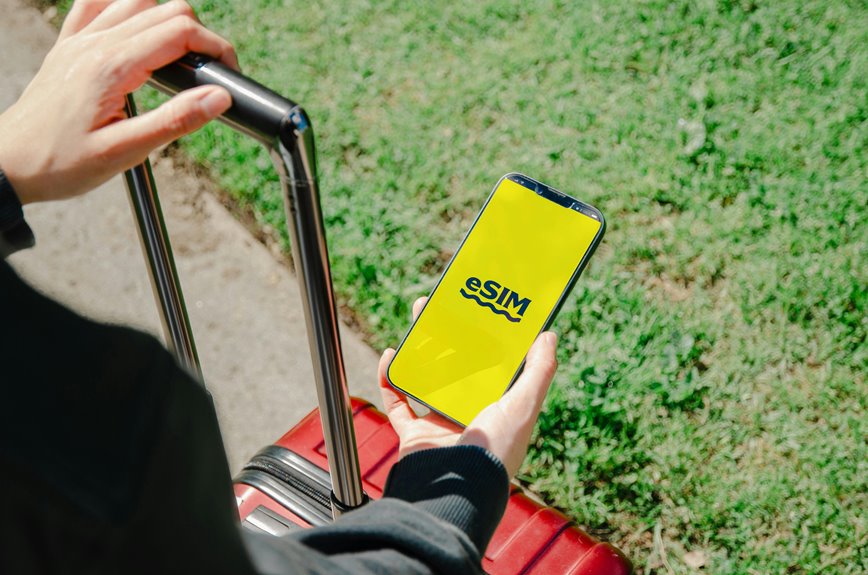
When you travel internationally, eSIM lets you activate a local or regional mobile plan remotely without buying or swapping a physical SIM card. You choose travel data plans before departure, then scan the carrier’s QR code or use its app. That gives you immediate coverage, predictable speeds, and roaming cost savings.
| Step | Action |
|---|---|
| 1 | Verify your phone supports eSIM in your destination region. |
| 2 | Buy the plan and install the profile over Wi-Fi. |
| 3 | Enable the line and test data before landing. |
Use your primary number for calls as needed, and keep data on the travel line. This setup helps you stay connected with your crew, avoid surprise charges, and keep control of usage while you’re abroad.
How to Switch Carriers With eSIM
Switching carriers with eSIM lets you change mobile plans without handling a physical SIM card, and you can usually complete the process through your carrier’s app, a QR code, or a remote provisioning link. You gain carrier switching benefits like faster onboarding, cleaner device management, and easier plan control.
- Verify your phone supports eSIM and is unlocked.
- Open the carrier app or scan the activation QR code.
- Follow the switching provider process to download the new profile.
- Confirm your line, then test calls, texts, and data.
You stay connected to your network community while moving between providers with minimal interruption. This workflow is precise, secure, and well suited if you want flexibility without losing continuity or belonging.
Common eSIM Activation Problems and Fixes
Even with a smooth carrier change, eSIM activation can fail at a few predictable points: device compatibility, carrier provisioning, QR-code setup, profile limits, or SIM-lock restrictions. You can troubleshoot activation errors via confirming your phone supports your carrier’s eSIM band and software version, then restarting the device and retrying provisioning. If the QR scan fails, focus on fixing qr code issues via checking brightness, camera focus, and one-time code validity.
| Problem | Fix |
|---|---|
| Unsupported device | Verify model and region |
| Carrier not provisioning | Ask support to resend profile |
| QR code won’t scan | Regenerate code or use manual entry |
If you’ve already loaded many profiles, delete an inactive one before. As a SIM lock blocks installation, ask your carrier to approve or approve the profile.
How eSIM Protects Your Number and Data
Because eSIM stores your mobile profile in a secure element inside the device, it protects your number and data without relying on a removable card. You keep tighter control over number privacy because carriers provision profiles remotely, and only authorized updates reach your line. Data encryption guards the authentication exchange, so attackers can’t easily read credentials in transit.
- Your profile stays bound to the device’s secure hardware.
- Your number isn’t exposed through a swappable card.
- Encrypted provisioning reduces interception risk.
- Carrier authentication limits unauthorized profile changes.
This design also helps you belong to a more secure mobile ecosystem, where you can switch plans with confidence. Your identity data remains protected by GSMA standards, and your service access stays consistent across trusted networks.
How eSIM Affects Phone Design
With eSIM, phone makers can rework the internal layout of a device by removing the physical SIM tray and its associated hardware, freeing space for slimmer designs or other components like larger batteries, antennas, or sensors.
You benefit from device miniaturization because engineers can use internal space savings more efficiently, packing more functionality into the same chassis. That shift also lets manufacturers tighten tolerances, reduce openings in the enclosure, and improve structural integrity.
In premium phones, you’ll often see that extra room allocated to thermal management or modem components, which can support more consistent performance. If you like devices that feel refined and integrated, eSIM helps create that fit. It doesn’t change the handset’s outward role, but it does let the hardware team optimize every cubic millimeter.
What’s Next for eSIM in Smartphones
As carriers expand remote provisioning and more manufacturers ship eSIM-first devices, the technology is moving from a convenience feature to a default connectivity model. You’ll see faster onboarding, fewer carrier barriers, and tighter integration with future device integrations across phones, wearables, and tablets.
- You can activate plans instantly through QR codes or app flows.
- You’ll manage multiple profiles for work, travel, and personal use.
- You’ll benefit from stronger standardization as the eSIM ecosystem evolution matures.
- You’ll move between devices with less friction and more control.
For you, that means a cleaner setup path and a shared, carrier-agnostic experience. As GSMA standards and eSIM-only models spread, your phone won’t just hold connectivity; it’ll orchestrate it with precision.
Frequently Asked Questions
Can an eSIM Be Transferred to a New Phone Instantly?
No, you usually cannot transfer an eSIM instantly. You may need to use your carrier’s transfer process, and some devices require a short activation delay.
How Many eSIM Profiles Can One Phone Store?
Most phones can save around 20 eSIM profiles, though the exact number depends on the device model and carrier support. In practice, you will usually keep 1 or 2 active at a time and swap between stored profiles when needed.
Do Carrier-Locked Phones Restrict Which eSIMs You Can Add?
Yes. If your phone is carrier locked, you will usually face carrier restrictions, so you can only add eSIMs from that carrier. Your eSIM compatibility still matters, but unlocking does not always remove the lock’s provisioning limits.
Can eSIMs Work on Smartwatches and Tablets Too?
Yes, eSIMs also work on smartwatches and tablets. On smartwatches, they enable calls and data without a phone nearby. On tablets, activation is usually done with a carrier QR code. This keeps your devices connected without needing a physical SIM card.
Will eSIM Replace Physical SIM Cards Worldwide by 2030?
Short answer: probably yes, but not completely. By 2030, eSIM is likely to dominate most markets as adoption grows, though older phones, carrier restrictions, and upgrade costs will keep some physical SIM cards in use.