
If you need reliable shotgun mics for pro video work, you want gear that locks onto dialogue, survives rough sets, and plays nicely with cameras, phones, and mixers. You’ll care about polar patterns, pads, filters, and power options-because clarity and consistency matter. I’ll compare trusted models like the Sennheiser MKE 400, RØDE VideoMic Pro+ and NTG, plus compact choices, so you can pick the right tool for the job.
| COMICA VM30 Shotgun Microphone for Camera Smartphone PC |

| Versatile Wireless Hybrid | Polar Pattern: Super‑cardioid | On‑camera / Mobile Use: Compatible with cameras, smartphones, computers (on‑camera and mobile) | Wind / Handling Noise Reduction: Super‑cardioid design reduces ambient noise; includes filters (low‑cut) | VIEW LATEST PRICE | Read Our Analysis |
| Sennheiser MKE 400 On-Camera Shotgun Microphone |
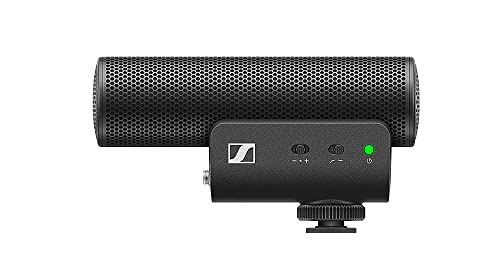
| Rugged Directional Classic | Polar Pattern: Super‑cardioid / directional | On‑camera / Mobile Use: On‑camera for DSLR/mirrorless and mobile devices | Wind / Handling Noise Reduction: Integrated wind protection and internal suspension mount | VIEW LATEST PRICE | Read Our Analysis |
| RØDE VideoMic Pro+ On-Camera Shotgun Microphone |

| Pro Run-and-Gun | Polar Pattern: Directional (shotgun) / focused pickup | On‑camera / Mobile Use: Designed for on‑camera filmmaking and content creation | Wind / Handling Noise Reduction: Rycote Lyre suspension and improved windshield | VIEW LATEST PRICE | Read Our Analysis |
| Rode VideoMic NTG Camera-mount Shotgun Microphone,Black |
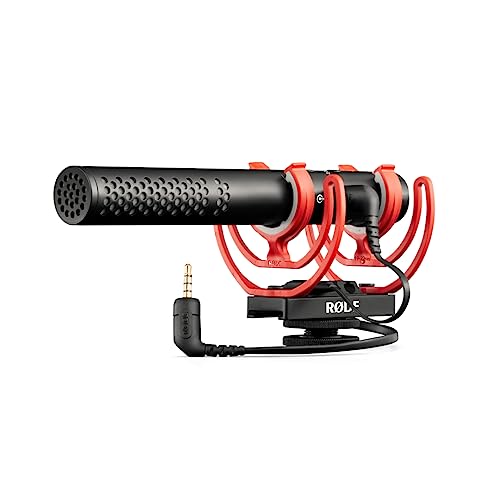
| Broadcast-Grade Flexibility | Polar Pattern: Shotgun / highly directional (NTG design) | On‑camera / Mobile Use: Optimized for on‑camera; also mobile/desktop via USB | Wind / Handling Noise Reduction: Broadcast design with options like high‑pass filter and safety channel (addresses noise); designed for low handling noise | VIEW LATEST PRICE | Read Our Analysis |
| Movo VXR10 Universal Shotgun Microphone for Cameras |

| Affordable Mobile Workhorse | Polar Pattern: Directional (shotgun) / focuses front | On‑camera / Mobile Use: For DSLR, camcorder, smartphone (phone adapters may be needed) | Wind / Handling Noise Reduction: Built‑in shock mount and fuzzy windscreen included | VIEW LATEST PRICE | Read Our Analysis |
More Details on Our Top Picks
COMICA VM30 Shotgun Microphone for Camera Smartphone PC
If you need a versatile on-camera mic that works seamlessly with cameras, smartphones, and PCs, the COMICA VM30 is built for you. You’ll switch between wired and wireless modes with one button, even using both at once. The 3.5mm intelligent auto-sensing output gives plug-and-play convenience while saving power. Its super-cardioid pattern and 48 kHz/24-bit sampling focus sound with clarity; dual low-cut filters (75/150 Hz) and a high-frequency boost tame rumble and enhance voices. USB-C and analog outputs, up to 100 m wireless range, under-20 ms latency, long battery life, and detailed gain and monitoring controls keep you efficient.
- Polar Pattern:Super‑cardioid
- On‑camera / Mobile Use:Compatible with cameras, smartphones, computers (on‑camera and mobile)
- Wind / Handling Noise Reduction:Super‑cardioid design reduces ambient noise; includes filters (low‑cut)
- Low‑cut / High‑pass Filtering:Dual low‑cut filters (75 Hz and 150 Hz)
- Monitoring / Output Options:USB‑C digital and 3.5mm analog outputs; receiver mirrors outputs; real‑time monitoring on receiver
- Power Options:Built‑in rechargeable battery (38 h wired / 14 h wireless); also works wired
- Additional Feature:Integrated wireless module
- Additional Feature:Stepless gain control
- Additional Feature:38h wired battery
Sennheiser MKE 400 On-Camera Shotgun Microphone
For videographers who need clear, focused audio on the go, the Sennheiser MKE 400 delivers a compact, highly directional solution that plugs straight into DSLR, mirrorless, or mobile devices. You’ll get a super-cardioid pattern that zeroes in on subjects while minimizing ambient noise. It uses interchangeable 3.5 mm TRS and TRRS connectors so you can switch between camera and phone. Built-in wind protection and an internal suspension mount cut handling and wind noise. A low-cut filter and 3-step sensitivity switch let you shape signal for different scenes, and the headphone jack with volume control lets you monitor in real time.
- Polar Pattern:Super‑cardioid / directional
- On‑camera / Mobile Use:On‑camera for DSLR/mirrorless and mobile devices
- Wind / Handling Noise Reduction:Integrated wind protection and internal suspension mount
- Low‑cut / High‑pass Filtering:Built‑in low‑cut filter
- Monitoring / Output Options:3.5mm TRS/TRRS connectors and integrated headphone output jack with volume for monitoring
- Power Options:Powered by camera/mobile plug‑in power (3.5mm TRS/TRRS)
- Additional Feature:Interchangeable TRS/TRRS
- Additional Feature:Internal suspension mount
- Additional Feature:Integrated headphone output
RØDE VideoMic Pro+ On-Camera Shotgun Microphone
The RØDE VideoMic Pro+ is ideal when you need a reliable, ready‑to‑go on‑camera shotgun that minimizes post‑production work; its digital switching captures clean, camera-ready audio with onboard controls like a high‑pass filter, pad, HF boost and safety channel. You’ll get Rycote Lyre suspension and an improved capsule/line tube with a better windshield to reduce handling noise and wind. Power is flexible: the LB-1 rechargeable battery, two AAs, or continuous Micro‑USB. The built‑in battery door stays attached for quick swaps. Automatic Power shuts the mic off when unplugged, and plug‑in power is supported for long shoots.
- Polar Pattern:Directional (shotgun) / focused pickup
- On‑camera / Mobile Use:Designed for on‑camera filmmaking and content creation
- Wind / Handling Noise Reduction:Rycote Lyre suspension and improved windshield
- Low‑cut / High‑pass Filtering:High‑pass filter included
- Monitoring / Output Options:3.5mm output and features for capture; supports monitoring workflows (camera monitoring)
- Power Options:Multiple: LB‑1 rechargeable battery, 2×AA, or continuous Micro‑USB power; automatic power features
- Additional Feature:Rycote Lyre suspension
- Additional Feature:Multiple power options
- Additional Feature:Automatic power function
Rode VideoMic NTG Camera-mount Shotgun Microphone,Black
Rode’s VideoMic NTG is ideal for content creators and DSLR shooters who need broadcast-grade sound in a compact, camera-mount package-its NTG5-derived acoustic design delivers transparent, uncoloured audio so your dialogue and ambient detail stay natural. You’ll get an auto-sensing 3.5mm output that switches between camera and mobile, plus it doubles as a headphone jack when you use USB. A USB interface lets you record to computers, tablets, and phones (iOS requires SC15). Digital controls provide high-pass, -20 dB pad, HF boost, safety channel, and infinite gain trim, making it versatile for on-camera, desktop, or mobile workflows.
- Polar Pattern:Shotgun / highly directional (NTG design)
- On‑camera / Mobile Use:Optimized for on‑camera; also mobile/desktop via USB
- Wind / Handling Noise Reduction:Broadcast design with options like high‑pass filter and safety channel (addresses noise); designed for low handling noise
- Low‑cut / High‑pass Filtering:High‑pass filter available (digital switching)
- Monitoring / Output Options:3.5mm auto‑sensing output that doubles as headphone output when using USB; USB digital interface for computer/mobile
- Power Options:Bus‑powered via USB (computer/mobile) and camera plug‑in power; internal power management (digital switching)
- Additional Feature:USB digital interface
- Additional Feature:Infinitely variable gain
- Additional Feature:NTG5-inspired design
Movo VXR10 Universal Shotgun Microphone for Cameras
If you want a compact, travel-ready shotgun that plugs straight into phones and cameras, the Movo VXR10 gives you directional audio without a steep learning curve. You’ll appreciate its solid aluminum body, built-in mount and compact form for hectic shoots. It works with iPhone, Android, DSLR, camcorders and laptops that offer a 3.5 mm mic input with plug-in power-note some Canon models don’t accept external mics. Use the correct TRS/TRRS cable and adapters for smartphones. Included windscreen, case, cables and shock mounts make outdoor vlogging, interviews and social clips cleaner. Over 100K creators choose it as a budget upgrade.
- Polar Pattern:Directional (shotgun) / focuses front
- On‑camera / Mobile Use:For DSLR, camcorder, smartphone (phone adapters may be needed)
- Wind / Handling Noise Reduction:Built‑in shock mount and fuzzy windscreen included
- Low‑cut / High‑pass Filtering:No explicit digital filter listed, but directional design and included shock/windscreen address low‑frequency rumble (requires device plug‑in power)
- Monitoring / Output Options:3.5mm output (requires correct TRS/TRRS cable); includes smartphone and camera cables for connection/monitoring via host device
- Power Options:Relies on device plug‑in power (3.5mm) for operation; no internal rechargeable battery mentioned
- Additional Feature:Solid aluminum body
- Additional Feature:Includes Rycote shock mount
- Additional Feature:Fuzzy windscreen included
Factors to Consider When Choosing Professional Video Microphones for Shotgun
When choosing a shotgun mic you’ll want to evaluate polar pattern and directionality to make sure it isolates the sound you need. Check frequency response, built-in filters, connectivity, and compatibility so the mic matches your camera and post workflow. Also consider power options, battery life, and build quality/handling for reliable performance on set.
Polar Pattern And Directionality
Dialing in the right polar pattern will make or break your shotgun mic’s ability to isolate dialogue from background noise, so you should focus on how directionality and frequency-dependent rejection affect real-world performance. Shotguns rely on supercardioid or lobar patterns and an interference tube to concentrate pickup on-axis while attenuating side and rear sounds. That interference design boosts off-axis rejection at mid-to-high frequencies, so distant or frontal sources stay clear. Remember patterns change with frequency: rejection usually improves as frequency rises but can collapse toward omnidirectional at low frequencies, letting rumble or room tone through. For cramped, noisy sets pick a narrower pattern for isolation, but aim precisely to avoid off-axis coloration. Always review manufacturers’ polar charts and on/off-axis frequency plots for your scenarios.
Frequency Response And Filters
Because low-end rumble and subtle HF boosts both shape how dialogue reads on camera, you should treat frequency response and onboard filters as central choices, not afterthoughts. Check for selectable high-pass filters (commonly ~75 Hz and 150 Hz) to remove wind, traffic, and handling rumble without harming intelligibility. Use a presence or HF-boost switch (around 3–6 kHz) to improve clarity on distant or noisy takes. Look at measured frequency-response curves-peaks can produce sibilance, dips reduce warmth-so you know when to engage filters or apply corrective EQ in post. Make certain the mic and recorder support professional sample rates (e.g., 48 kHz/24-bit) to preserve detail. Also consider pads/attenuation (-10 to -20 dB) to avoid overload that ruins usable frequency content.
Connectivity And Compatibility
You’ve sorted frequency response and filters to get the sonic character you want; now make sure the mic actually talks to the rest of your kit. Check the physical outputs-3.5 mm TRS for cameras, TRRS for many phones, or USB‑C/USB‑A for direct digital feeds-and confirm any adapters or cables you’ll need for iOS/Android or specific camera ports. Know the mic’s power requirements (plug‑in, phantom 48V, battery, or built‑in rechargeable) so it matches your recorder without extra converters. Look for auto‑sensing or switchable analog/digital modes and guarantee the receiver outputs you need. Verify monitoring and variable gain work when connected to your target device for real‑time control. For wireless, confirm range, latency, and whether receiver outputs integrate with multi‑device setups.
Power Options And Battery Life
Your microphone’s power scheme will shape how long and how reliably it performs on set, so check available modes-internal rechargeable, replaceable AAs, and external USB-before you commit. Compare stated runtimes for each mode and plan conservatively using the shortest quoted figure; wired analog operation often lasts longest, while digital or wireless modes can draw more power and shorten runtime. Favor models offering multiple power options so you can hot-swap batteries or run from USB/phantom power during long takes. Check for automatic power-saving features like intelligent sleep or auto-off when unplugged to extend usable life. Finally, consider how each power mode affects functionality and latency so you don’t trade battery life for unacceptable performance.
Build Quality And Handling
When you’re choosing a shotgun for video work, build quality and handling determine how reliably the mic performs in real conditions and how easy it feels to use on set. You’ll want a rigid, corrosion-resistant housing (aluminum or magnesium alloys) that resists drops and won’t add unnecessary weight. Check for an integrated or high-quality shock/mount to isolate handling and camera vibration, cutting low-frequency thumps. Make sure weather sealing or at least water- and dust-resistant construction plus a secure windshield fit for dependable outdoor use. Inspect controls and connectors: metal thread mounts, durable switches, and reinforced sockets survive repeated use and are easy to operate while filming. Finally, choose tool-free, captive battery doors or external rechargeable options to minimize downtime and lost parts.