
If you’re picking an aluminum case in 2026, you’ll want something that balances cooling, build quality, and compact design without compromises. I’ll compare five top options-from ultra‑compact SFF and HTPC builds to open‑frame rigs-so you can see which fits your priorities and cooling plans. Keep going and you’ll find the case that actually makes your next build smoother and quieter.
| JOYJOM Aluminum Mini ITX SFF Gaming PC Case |
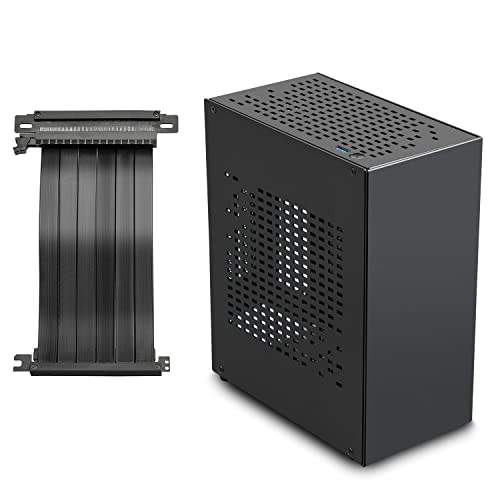
| Compact Gamer | Form factor / Type: Mini-ITX / SFF enclosed case | Material: Aluminum alloy body (2.0 mm) | Motherboard compatibility: Mini-ITX (170 × 170 mm) | VIEW LATEST PRICE | Read Our Analysis |
| Mini Aluminum Open Frame PC Case Assembly |

| Customizable Open-Frame | Form factor / Type: Mini open-frame ITX assembly frame | Material: Aluminum alloy frame (+ acrylic panels) | Motherboard compatibility: ITX (≤ 170 × 170 mm) | VIEW LATEST PRICE | Read Our Analysis |
| Aluminum Alloy Open-Frame Gaming PC Case |

| Enthusiast Builder | Form factor / Type: Open-frame ATX/ITX-compatible chassis (frame only) | Material: Aluminum alloy frame/bracket | Motherboard compatibility: ITX, uATX, mATX, ATX (supports ITX) | VIEW LATEST PRICE | Read Our Analysis |
| G60S Mini-ITX Aluminum Gaming HTPC Case |

| Silent HTPC | Form factor / Type: Mini-ITX HTPC full-aluminum case | Material: Full-aluminum shell (anodized/drawn finish) | Motherboard compatibility: Mini-ITX (170 × 170 mm) | VIEW LATEST PRICE | Read Our Analysis |
| Teenage Engineering Computer-1 Mini-ITX Aluminum PC Case |

| Design-Forward Mini | Form factor / Type: Mini-ITX compact/aluminum chassis (flat-pack kit) | Material: Aluminum (powder‑coated or raw aluminum variants) | Motherboard compatibility: Mini-ITX | VIEW LATEST PRICE | Read Our Analysis |
More Details on Our Top Picks
JOYJOM Aluminum Mini ITX SFF Gaming PC Case
If you want a compact, high-quality SFF build that doubles as a passive heatsink, the JOYJOM Aluminum Mini ITX case is a smart pick – its 2.0 mm aluminum body shuttles heat away while fitting a Mini‑ITX board, a Flex‑Small 1U PSU, and a GPU up to 17 × 10 × 4 cm in just 4.3 liters. You’ll appreciate its precise 18.4 × 10.4 × 22.3 cm footprint and included PCIe 3.0 riser cable. It supports two 2.5‑inch SSDs (<9 mm) and low‑profile coolers (<36 mm). The black finish looks premium, assembly’s straightforward, and the parts list is complete.
- Form factor / Type:Mini-ITX / SFF enclosed case
- Material:Aluminum alloy body (2.0 mm)
- Motherboard compatibility:Mini-ITX (170 × 170 mm)
- Drive/storage support:2 × 2.5″ SSD (≤ 9 mm)
- GPU / expansion card support:GPU up to 17 × 10 × 4 cm
- User assembly / included accessories:Includes PCIe 3.0 riser cable and screws (case arrives assembled/ready with accessories)
- Additional Feature:Built-in PCIe riser cable
- Additional Feature:2.0 mm aluminum body
- Additional Feature:Compact 4.3 L volume
Mini Aluminum Open Frame PC Case Assembly
For builders who prioritize airflow and customization, this mini open aluminum alloy frame gives you a lightweight, modular platform that’s perfect for compact ITX rigs. You’ll assemble a blocks-style frame from 20×20 aluminum alloy and acrylic panels into a 31×21×14 cm chassis weighing about 907 g. It fits ITX motherboards (≤170×170 mm), a standard ATX PSU, one 3.5/2.5-inch drive position, and two expansion slots. The open-frame layout boosts cooling and simplifies maintenance; remove protective film from acrylic for clarity. Parts include colored brackets, screws, auxiliary bits, and instructions-plan disassembly beforehand and confirm motherboard size before buying.
- Form factor / Type:Mini open-frame ITX assembly frame
- Material:Aluminum alloy frame (+ acrylic panels)
- Motherboard compatibility:ITX (≤ 170 × 170 mm)
- Drive/storage support:1 × extended hard disk position (1 HDD/slot)
- GPU / expansion card support:2 PCI/expansion slots (ATX PSU-compatible frame)
- User assembly / included accessories:User-assembled; includes brackets, screws, auxiliary parts, instructions
- Additional Feature:20×20 aluminum profile
- Additional Feature:Start/restart switch included
- Additional Feature:Modular/nude build design
Aluminum Alloy Open-Frame Gaming PC Case
The Aluminum Alloy Open-Frame Gaming PC Case is ideal if you want a build-focused chassis that showcases components and prioritizes custom water cooling; its lightweight aluminum frame and multi-radiator support (120/240/360 mm) make it a great choice for modders and testers who need easy access and visible airflow. You’ll get an ATX-compatible open-frame bracket (36×30×20 cm) that fits ITX to ATX boards, supports two HDDs and two SSDs, and leaves CPU air-cooling height unrestricted. It ships as a frame-only kit with mounts, anti-vibration pads, toolbox items, a GPU holder, one USB 3.0 port, and requires assembly.
- Form factor / Type:Open-frame ATX/ITX-compatible chassis (frame only)
- Material:Aluminum alloy frame/bracket
- Motherboard compatibility:ITX, uATX, mATX, ATX (supports ITX)
- Drive/storage support:Up to 2 × HDD + 2 × SSD (model-dependent)
- GPU / expansion card support:Supports horizontal (default) and vertical (with extension) GPU; motherboard length ≤ 30 cm
- User assembly / included accessories:Frame only; assembly required; includes brackets, screws, toolkit, GPU holder, cable ties (varies by model)
- Additional Feature:Multi-radiator support (120/240/360)
- Additional Feature:Graphics card holder included
- Additional Feature:Supports up to ATX motherboards
G60S Mini-ITX Aluminum Gaming HTPC Case
You’ll appreciate the G60S Mini-ITX Aluminum Gaming HTPC Case when you want a lightweight, premium-looking enclosure that stays whisper-quiet in a living-room setting. You’ll get a full-aluminum shell with a refined drawn-and-anodized finish that feels delicate and looks upscale. It fits Mini-ITX 170 x 170 mm motherboards and uses a DC ATX power supply. Storage choices include two 2.5-inch drives or one 3.5-inch drive, keeping builds compact. Mount it horizontal, vertical, or on a wall for living rooms, hotels, digital signage, or kiosks. It runs without noise, making it ideal for peaceful daily use.
- Form factor / Type:Mini-ITX HTPC full-aluminum case
- Material:Full-aluminum shell (anodized/drawn finish)
- Motherboard compatibility:Mini-ITX (170 × 170 mm)
- Drive/storage support:2 × 2.5″ or 1 × 3.5″ drive
- GPU / expansion card support:Mini-ITX oriented (suitable for HTPC GPUs; not specified long GPUs)
- User assembly / included accessories:Ready-to-use aluminum shell with mounting options (assembly/mounting hardware implied)
- Additional Feature:Wall-mountable orientation
- Additional Feature:Full-aluminum anodized finish
- Additional Feature:Runs noiselessly
Teenage Engineering Computer-1 Mini-ITX Aluminum PC Case
If you want a compact, design-forward Mini‑ITX case that’s easy to put together, the Teenage Engineering Computer‑1 is built for makers who value aesthetics and portability. You get a powder‑coated RAL 2004 orange or raw aluminum flat‑pack chassis with chrome handles rated to support full‑tower weight. Its exterior (with handles) measures 7.48 x 6.69 x 12.68 inches; interior fits Mini‑ITX boards with 5.79‑inch motherboard‑to‑case width. It accepts SFX PSUs, dual‑slot GPUs up to 7 inches, and CPU coolers up to 4.72 inches. The kit includes aluminum sheets and an illustrated guide; components aren’t included. Model TE030AS002, 2.57 lb.
- Form factor / Type:Mini-ITX compact/aluminum chassis (flat-pack kit)
- Material:Aluminum (powder‑coated or raw aluminum variants)
- Motherboard compatibility:Mini-ITX
- Drive/storage support:Designed for standard SFF storage (fits typical mini‑ITX components; specifics implied by SFX/GPU limits)
- GPU / expansion card support:Dual-slot GPU up to 7″ length
- User assembly / included accessories:DIY flat-pack kit requiring user assembly; includes build guide and aluminum panels
- Additional Feature:Chrome metal carrying handles
- Additional Feature:DIY flat-pack kit
- Additional Feature:SFX power supply support
Factors to Consider When Choosing Aluminum Computer Cases
When picking an aluminum case, you’ll want to balance thermal conductivity and cooling options with weight and portability so your system stays cool without becoming a burden to move. Check build quality and finish, confirm component compatibility limits like GPU and cooler clearance, and think about noise and vibration control for a quieter setup. These factors will determine whether the case fits your performance, durability, and everyday-use needs.
Thermal Conductivity And Cooling
Heat management matters more than aesthetics in aluminum cases, because aluminum’s high thermal conductivity (about 205 W/m·K) helps spread heat from hot components into the chassis where it can dissipate. You’ll benefit from thin (1–3 mm) panels that transfer heat quickly to the shell, though they hold little thermal mass during spikes. Choose open-frame or well-ventilated designs to boost convective cooling; fully enclosed boxes need deliberate venting and fan placement to avoid hotspots. Where possible, mount heat-generating components to the chassis-M.2/SSD brackets or VRM contact points-using good thermal interfaces so the case passively lowers local temperatures. Remember conduction helps, but it can’t replace active airflow management: fan size, intake/exhaust balance, and unobstructed vents remain essential.
Weight And Portability
Because aluminum cuts chassis weight by roughly a third to half compared with steel, you’ll notice real benefits in lifting and transporting a build-but don’t assume the empty case tells the whole story. Check both case and chassis weights, then add PSU, GPU, drives, and cooling to estimate total system mass. Thinner aluminum panels save pounds but can reduce rigidity and raise vibration, so balance lightness against stability. If you’ll move the rig often, favor integrated handles, removable panels, or flat-pack designs to ease carrying without much added mass. For travel, prioritize shock resistance and secure mounting points-drive cages and GPU brackets-that keep parts fixed, since lighter aluminum transmits impacts more directly to components.
Build Quality And Finish
Inspect the case closely: panel thickness, alloy quality, and construction methods tell you how well it’ll hold up over time. You want panels near or above 2.0 mm and a proper aluminum alloy for rigidity, vibration damping, and heat spreading; thinner sheets flex and vibrate. Check for seamless CNC-milled parts or anodized/drawn finishes-those resist corrosion and scratches better than painted or bonded surfaces. Verify solid mounting points and threaded standoffs so repeated builds won’t strip threads or deform the frame. Examine joint design: bolted, dovetail, or CNC-fitted joins give tighter tolerances and less flex than snap-fit or riveted assemblies. Finally, confirm precise cutouts, cable routing channels, and drive mounts-good tolerances simplify assembly and improve long-term durability.
Component Compatibility Limits
Once you’ve confirmed the case’s build quality and mounting precision, check the component compatibility limits so your parts fit and function without compromises. First verify supported motherboard form factors (Mini‑ITX, mATX, ATX) and the case’s maximum motherboard dimensions in millimeters to avoid layout conflicts. Confirm GPU length, width, and slot-count allowances in mm or inches so the card won’t block airflow or adjacent connectors. Make certain the power supply type (SFX, SFX‑L, ATX, DC‑ATX, Flex‑1U) and maximum PSU dimensions provide cabling clearance. Review storage mounting: number and sizes of 2.5″ and 3.5″ bays and maximum drive thickness. Finally, check CPU cooler clearance-maximum heatsink height or profile-and remember tall RAM heatsinks or VRM cooling can reduce usable space.
Noise And Vibration Control
When you’re choosing an aluminum case, pay close attention to how it handles noise and vibration since metal panels and hard-mounted components can easily transmit and amplify sound. Prefer thicker panels (≥2.0 mm) to reduce panel resonance and panel-borne noise. Check for solid mounting points with anti-vibration grommets or rubber washers on drives and fans to cut audible rattles. If you like open or ventilated designs, look for cases that include acoustic damping or localized baffles to contain noise without killing airflow. Make certain stiff internal bracing and properly torqued fasteners to prevent chassis flex that amplifies coil whine and mid/high buzzing. Finally, isolate PSU and GPU with rubber mounts or decouplers and opt for low-vibration fans rated by bearing type and SFP/CFM.
Expandability And Mounting
Noise management is only part of choosing an aluminum case; you also need to make sure it can grow with your build. Check motherboard form-factor support (Mini‑ITX, Micro‑ATX, ATX) and confirm the case’s mounting hole pattern and dimensions match your board so standoffs and I/O align correctly. Verify expansion slot count and orientation, and whether a PCIe riser is required or included for vertical GPU or capture-card installs. Confirm drive mounts: number, type (2.5″ vs 3.5″), locations, and maximum drive thickness/length for your SSDs/HDDs. Review GPU length, CPU cooler height, and PSU form-factor clearances (SFX, ATX, Flex). Prefer cases with modular mounting-removable brackets, adjustable bays, and radiator or vertical‑GPU mounting points-to simplify upgrades.
Final Thoughts
You’ll get the best balance of cooling, weight and style by choosing an aluminum case that matches your build goals and space. Aluminum conducts heat about three times better than steel, so a well-designed aluminum chassis can cut internal temperatures and fan noise noticeably-especially important in compact Mini‑ITX builds. Pick the JOYJOM if you want passive-friendly cooling, the G60S for quiet HTPC use, or an open‑frame for maximum airflow and modability.