
If you travel internationally, you’ll want a compact, reliable 220V converter that safely powers phones, tablets, cameras, and other small gadgets. Pick a model with enough continuous wattage, USB ports, and built‑in protections like thermal cutoff and resettable breakers. I’ll point out top step‑up and universal options, what to watch for with frequency and plugs, and how to avoid overheating or voiding warranties-so you can choose with confidence.
| Yinleader 300W 110V-to-220V Step-Up Voltage Converter | Compact Step-Up | Voltage conversion direction: Step-up (110–120V input → 220–240V output) | Target use case: Travel/portable use for low-power electronics | Power rating (maximum): 300 W (max), recommended continuous ≤200 W | VIEW LATEST PRICE | Read Our Analysis | |
| BESTEK Universal Travel Adapter 220V-110V with 4 USB |

| Travel Power Hub | Voltage conversion direction: Step-down (100–240V input → 110–120V output) – functions primarily to convert higher-voltage regions to 110–120V for US devices | Target use case: Travel charging for mobile devices and travel electronics | Power rating (maximum): 250 W (max AC) | VIEW LATEST PRICE | Read Our Analysis |
| Key Power 230W Step-Down 220V to 110V Converter |
| Multi-Outlet Travelizer | Voltage conversion direction: Step-down (220/240V → 110/120V) | Target use case: International travel use to run US appliances overseas | Power rating (maximum): 230 W (max) | VIEW LATEST PRICE | Read Our Analysis |
More Details on Our Top Picks
Yinleader 300W 110V-to-220V Step-Up Voltage Converter
Compact Step-Up
View Latest PriceIf you need a compact, travel-ready step-up converter for low-power gadgets, the Yinleader 300W (VTUS-300) is a solid choice – it converts 110–120V to 220–240V while protecting devices with a resettable circuit breaker and a recommended continuous load under 200W for long-term reliability. You’ll plug it in without configuration; its 3.85-pound, compact build fits luggage. Use it for phones, tablets, cameras, audio gear, shavers, and chargers. Don’t connect high-power appliances like hair dryers, kettles, or induction stoves. Remember it changes voltage only, not frequency, so some equipment may still behave differently.
- Voltage conversion direction:Step-up (110–120V input → 220–240V output)
- Target use case:Travel/portable use for low-power electronics
- Power rating (maximum):300 W (max), recommended continuous ≤200 W
- Built-in protections / safety features:Resettable circuit breaker (overload protection)
- USB charging capability:Not specified as having USB ports (intended for low-power electronics via AC)
- Travel-friendly / compact design:Portable, compact; weight 3.85 lb; small package dimensions
- Additional Feature:Resettable circuit breaker
- Additional Feature:Compact portable weight
- Additional Feature:Plug-and-play operation
BESTEK Universal Travel Adapter 220V-110V with 4 USB
Pick the BESTEK Universal Travel Adapter 220V to 110V if you need a compact, all-in-one converter that powers up to seven devices at once-three AC sockets and four USB ports with a combined 6A output-while protecting your gear with NRTL-tested safety features and an 18-month warranty. You’ll get 100–240V to 110–120V conversion with up to 250W on AC outlets and four USB ports delivering 0–2.4A each. It’s compact (about 6 x 3 x 1.57 inches), works in 150+ countries, and includes over-current, overload, overheating, and short-circuit protection with a red indicator light. Don’t use it for high-watt appliances like hair dryers or kettles.
- Voltage conversion direction:Step-down (100–240V input → 110–120V output) – functions primarily to convert higher-voltage regions to 110–120V for US devices
- Target use case:Travel charging for mobile devices and travel electronics
- Power rating (maximum):250 W (max AC)
- Built-in protections / safety features:Over-current, overload, overheat, short-circuit protections; short-circuit indicator
- USB charging capability:Four USB ports (combined 6A; up to 2.4A per port)
- Travel-friendly / compact design:Compact travel size (6 x 3 x 1.57 in listed; item weight 1.15 lb)
- Additional Feature:Four USB ports
- Additional Feature:NRTL-tested safety
- Additional Feature:18-month warranty
Key Power 230W Step-Down 220V to 110V Converter
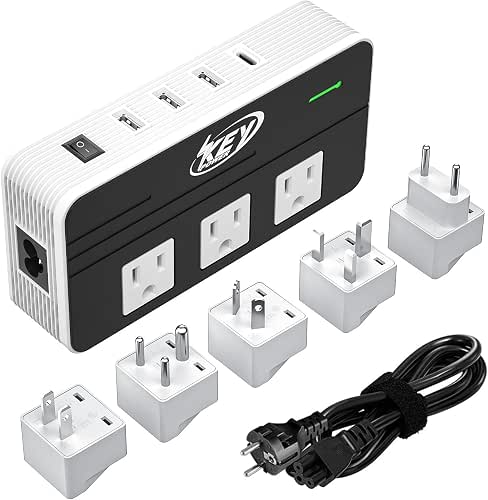
Choose the Key Power 230W Step-Down Converter when you need a compact, travel-ready unit that safely runs small US appliances abroad while charging multiple devices via its USB-C PD 18W and three USB-A ports. You’ll get true 220/240→110/120V conversion, built-in UK/US/AU/IN/EU sockets, and protections for over-current, over-temperature, short-circuit, and overload. The USB outputs are isolated from AC power, and the 230W limit means you shouldn’t run hair dryers, power tools, or any device over the wattage cap. It’s lightweight (11.2 oz), portable (6.35×3.2×1.58 in), and suits laptops, shavers, clippers, and small appliances.
- Voltage conversion direction:Step-down (220/240V → 110/120V)
- Target use case:International travel use to run US appliances overseas
- Power rating (maximum):230 W (max)
- Built-in protections / safety features:Over-current, over-temperature, short-circuit, overload protections
- USB charging capability:Four USB ports (1 USB-C PD 18W + 3 USB-A)
- Travel-friendly / compact design:Compact dimensions (6.35 × 3.2 × 1.58 in); lightweight (11.2 oz)
- Additional Feature:Built-in international sockets
- Additional Feature:USB-C PD 18W
- Additional Feature:Patent-protected design
Factors to Consider When Choosing 220V Power Converters
When choosing a 220V power converter, you’ll want to check the power rating to match your device’s wattage and confirm voltage and frequency compatibility for the country you’re visiting. Make a clear device compatibility list and prioritize safety protection features like surge, overload, and short-circuit protection. Also consider portability and size so the unit fits your luggage and travel needs.
Power Rating Capacity
Because mismatching a converter’s rating can overheat the unit or trip breakers, you should pick a model whose continuous wattage comfortably exceeds your device’s peak draw-ideally by 20–25%. Check the converter’s continuous rating (not just surge) and make sure it covers both running and startup (inrush) currents for motors, compressors, or any appliance with a coil or heating element. For small electronics and chargers, 150–300 W converters usually suffice; for heaters, coffee makers, or motorized gear, look at 1000 W or higher. If you’ll run several devices at once, add their continuous wattages and choose a converter above that combined total with the same 20–25% safety margin to avoid overheating and nuisance trips.
Voltage And Frequency
After sizing the converter for wattage, you’ll need to verify voltage and frequency compatibility so your gear runs correctly and safely. Make sure the converter’s voltage rating matches both source and device: step-up units must accept 110–120V input and deliver stable 220–240V output, and step-down units the reverse. Note most consumer converters change only voltage, not frequency-50 Hz vs 60 Hz differences can impair timing motors, clocks, and some appliances. Match continuous wattage to actual draw with a 20–30% safety margin, and confirm peak/surge capacity for motorized or inductive loads to handle high starting currents. Finally, check voltage regulation and output tolerance specs so sensitive electronics won’t suffer harmful spikes or drops.
Device Compatibility List
Many travelers rely on converters, but you should check a few key compatibility factors before plugging in any device. First, match converter type and direction: confirm step-up (110→220) or step-down (220→110) and remember converters don’t change AC frequency. Check wattage: make certain your device’s continuous draw stays below the converter’s recommended continuous-use limit (aim for under ~70–90% of max output) and avoid high-wattage heaters unless explicitly supported. Know the converter design-transformer-based or electronic-so motorized or inductive loads and sensitive electronics get appropriate handling; some gear requires a true sine wave. For phones and small gadgets, verify auxiliary outputs (USB/PD) and per-port amperage (e.g., 2.4A, 18W PD) to make certain proper charging.
Safety Protection Features
You’ve already checked device type, direction, and wattage – now focus on safety protections that keep both your gear and you safe. Make sure the converter includes overload protection, such as a resettable circuit breaker or automatic shutoff, so an overdraw won’t damage devices or cause a fire. Prioritize units with thermal cutoff/over-temperature protection that shuts the unit down if internal temps climb too high. Short-circuit and over-current protection should interrupt faults and prevent sparks or component failure. Confirm proper insulation, a grounded output, and compliance with safety standards or third-party testing to reduce shock risk. Finally, choose converters with clear warning labels and explicit protection limits so you don’t misuse them with high-power or inductive loads.
Portability And Size
When packing for a trip, prioritize a converter’s weight and dimensions so you don’t lug unnecessary bulk-aim for units under about 2 pounds with compact footprints (roughly 6 x 3 x 1.5 inches) for easy stashing. Check whether the unit has a small integrated plug or compact detachable cable to avoid blocking adjacent outlets and to save space in your bag. Match form factor to needs: single-purpose step-up/step-down boxes are bulkier than travel adapters with built-in sockets and USB ports, so pick based on how many devices you’ll carry. Mind ventilation and enclosure size-compact, high-efficiency converters can run hot, so leave clearance and never stuff them into tightly packed luggage. Balance portability against continuous wattage requirements.
Plug And Socket Types
Portability and plug compatibility go hand in hand: a lightweight converter won’t help if its plug doesn’t fit the wall or your device’s plug won’t mate with it. Confirm the plug type of both the power source and your device-Type A, C, G, I, etc.-so you don’t force or modify pins. Check socket grounding: if your device needs a three-prong earth connection, make sure the destination socket and converter provide it. Verify voltage and current ratings stamped on sockets and plugs, and match them to the converter’s input/output amperage to prevent overheating or poor contact. Consider plug orientation, size, and spacing; bulky plugs can block adjacent outlets. For multi-region travel, choose converters listing supported socket types rather than relying on improvised adapters.
Efficiency And Heat Output
Because converter efficiency directly affects how much power is wasted as heat, you should pick a unit with margins above your typical load rather than sizing it to the absolute maximum. Conversion efficiency usually runs ~85%–>92%, so a 200 W device can force 16–30 W of dissipation depending on design. Running continuous loads near rating raises heat nonlinearly, shortens lifespan and risks thermal shutdown. Transformers lose heat steadily; switch‑mode units concentrate heat in power components and heat sinks. Also expect lower efficiency at partial loads and transient start‑up inrush spikes, which produce brief heat surges. Choose converters with rated operating temperatures, good ventilation, and built‑in thermal protection, and keep recommended continuous load well below maximum to minimize overheating.
Warranty And Certifications
Heat and longevity concerns naturally lead you to check a converter’s warranty and safety certifications before buying. Verify recognized marks like NRTL, CE, UL, or ETL so the unit meets electrical and fire-safety standards. Check warranty length and scope-most run one to two years-and confirm coverage for defects, power surges, and return shipping. If you’ll run devices near rated wattage, make certain the warranty explicitly covers continuous or heavy-duty use; some exclude misuse or overload. Look for documented protections (overload, over-current, over-temperature, short-circuit) and confirm triggering them won’t void coverage. Finally, make sure the manufacturer provides clear claim procedures and reachable support (phone, email, online portal) and note any proof-of-purchase requirements.