
Like discovering a key to a hidden vault, you’ll find adapters that open your Nikon F glass to new mounts and creative freedom. You’ll want ones that fit precisely, hold infinity focus, and match the features you need-manual control or full autofocus-so your shooting doesn’t suffer. There’s more to weigh than metal or plastic, and a few choices stand out that might change how you use your lenses.
| Fotodiox Nikon F to Canon EOS Lens Adapter |

| Manual Precision | Purpose / Function: Mount Nikon F lenses to Canon EOS bodies | Mount Compatibility (Lens side): Nikon F (Nikkor F) mount | Mount Compatibility (Camera side): Canon EOS (EF, EF‑S) | VIEW LATEST PRICE | Read Our Analysis |
| K&F Concept Nikon F to Canon EF Lens Adapter |

| Versatile Compatibility | Purpose / Function: Mount Nikon F/AF/AI/AI-S lenses to Canon EOS EF/EF-S bodies | Mount Compatibility (Lens side): Nikon F / Nikkor F (AF, AI, AI-S) | Mount Compatibility (Camera side): Canon EOS (EF, EF‑S) and some cinema EF mounts | VIEW LATEST PRICE | Read Our Analysis |
| K&F Concept Nikon F to Canon EOS Adapter |
| Easy Alignment | Purpose / Function: Mount Nikon F/AF/AI/AI-S lenses to Canon EOS EF/EF-S bodies | Mount Compatibility (Lens side): Nikon F / Nikkor F (AF, AI, AI-S) | Mount Compatibility (Camera side): Canon EOS (EF, EF‑S) | VIEW LATEST PRICE | Read Our Analysis |
| Nikon FTZ Mount Adapter for F‑Mount to Z |

| Nikon Official Bridge | Purpose / Function: Mount Nikon F-mount Nikkor lenses to Nikon Z bodies | Mount Compatibility (Lens side): Nikon F-mount | Mount Compatibility (Camera side): Nikon Z mount | VIEW LATEST PRICE | Read Our Analysis |
| Nikon FTZ II – Adapter for F-Mount Lenses on Z-Mount Cameras |
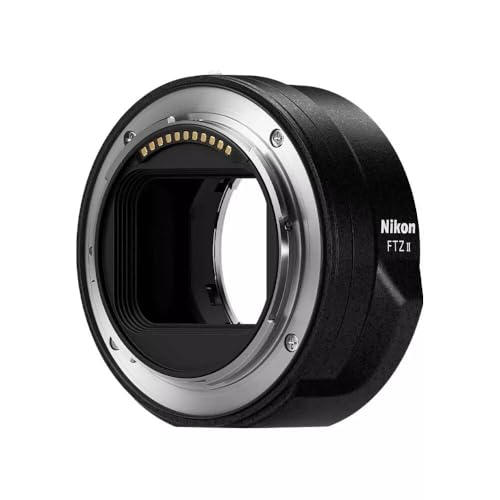
| Professional-Grade | Purpose / Function: Mount Nikon F-mount lenses to Nikon Z-mount cameras | Mount Compatibility (Lens side): Nikon F-mount | Mount Compatibility (Camera side): Nikon Z mount | VIEW LATEST PRICE | Read Our Analysis |
More Details on Our Top Picks
Fotodiox Nikon F to Canon EOS Lens Adapter
If you want a sturdy, all‑metal adapter that lets you mount Nikon F glass on Canon EOS bodies while keeping infinity focus, the Fotodiox Nikon F to Canon EOS adapter is a smart choice-its hardened anodized aluminum build and precision craftsmanship mean you’ll get a tight, reliable fit for manual shooting. You’ll mount Nikkor F/SLR lenses to EF or EF‑S bodies confidently, knowing the high‑tolerance design preserves infinity focus. It’s purely manual, so you’ll control aperture and focus on the lens itself. This premium‑grade Fotodiox unit includes a limited two‑year warranty, offering added assurance for long‑term use.
- Purpose / Function:Mount Nikon F lenses to Canon EOS bodies
- Mount Compatibility (Lens side):Nikon F (Nikkor F) mount
- Mount Compatibility (Camera side):Canon EOS (EF, EF‑S)
- Infinity Focus Support:Supports infinity focus
- Manual / Electronic Behavior:Manual adapter (mechanical; no electronic communication)
- Construction / Materials:All-metal, hardened anodized aluminum
- Additional Feature:All-metal craftsmanship
- Additional Feature:Supports infinity focus
- Additional Feature:2-year limited warranty
K&F Concept Nikon F to Canon EF Lens Adapter
Choose the K&F Concept Nikon F to Canon EF adapter when you want a solid, all-metal solution that preserves infinity focus and manual iris control for Nikon F/AI/AI-S glass on Canon EF bodies. You get a premium-grade brass and anodized aluminum mount that’s durable, smooth to mount, and precisely machined. It supports infinity with a slight positive shift marked by an L-shaped line-check focus through the viewfinder, especially on long lenses. Diaphragm control stays manual on the lens. Compatibility spans Canon EOS DSLR and many cinema EF-mount cameras. Expect stable mechanical coupling and predictable performance across varied shooting conditions.
- Purpose / Function:Mount Nikon F/AF/AI/AI-S lenses to Canon EOS EF/EF-S bodies
- Mount Compatibility (Lens side):Nikon F / Nikkor F (AF, AI, AI-S)
- Mount Compatibility (Camera side):Canon EOS (EF, EF‑S) and some cinema EF mounts
- Infinity Focus Support:Supports infinity focus (with slight positive shift marking)
- Manual / Electronic Behavior:Manual control for diaphragm and focus (mechanical)
- Construction / Materials:Brass and anodized aluminum (not plastic)
- Additional Feature:Manual diaphragm control
- Additional Feature:Brass + aluminum build
- Additional Feature:Cinema camera compatibility
K&F Concept Nikon F to Canon EOS Adapter
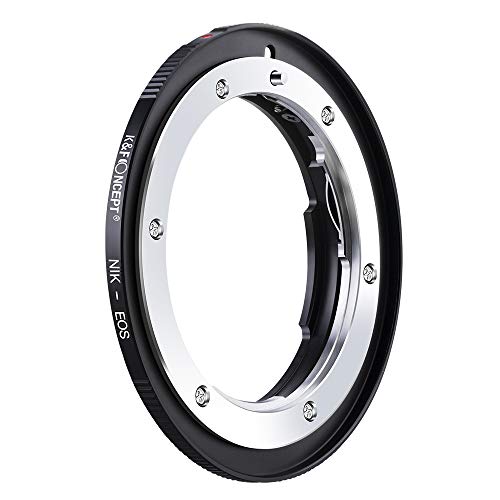
Photographers who want a sturdy, all‑metal adapter that preserves infinity focus will appreciate the K&F Concept Nikon F to Canon EOS Adapter; it lets you mount Nikon F/AI/AI‑S lenses on Canon EF/EF‑S bodies while keeping manual focus and exposure control. You’ll get a hardened anodized aluminum body with interior matting varnish to reduce reflections and a red alignment dot for quick, precise mounting. It supports Nikon F/AF, AI, AI‑S lenses and many Canon DSLRs (1D series, 5D series, 7D, Rebel series, and more). Enable “Release shutter without lens” on your camera. Compact and light at 1.72 ounces.
- Purpose / Function:Mount Nikon F/AF/AI/AI-S lenses to Canon EOS EF/EF-S bodies
- Mount Compatibility (Lens side):Nikon F / Nikkor F (AF, AI, AI-S)
- Mount Compatibility (Camera side):Canon EOS (EF, EF‑S)
- Infinity Focus Support:Supports focus to infinity
- Manual / Electronic Behavior:Manual focus and manual exposure (mechanical)
- Construction / Materials:All-metal, hardened anodized aluminum with interior matting varnish
- Additional Feature:Interior anti-reflective matting
- Additional Feature:Precision alignment red dot
- Additional Feature:Requires menu shutter release
Nikon FTZ Mount Adapter for F‑Mount to Z
The FTZ adapter is the best pick for Nikon shooters who want to keep using their F‑mount glass on Z bodies without losing autofocus or exposure automation-it’s compatible with over 360 F‑mount Nikkors (including many AF‑S, AF‑P, AF‑I, and teleconverter combinations). You get full AF/AE with supported AF‑S, AF‑P, AF‑I and teleconverter pairings, preserved sharpness, and seamless integration with Z‑system features like in‑camera VR, hybrid AF, silent shooting, and focus peaking. Built from magnesium alloy and weather‑sealed, the precision FTZ feels solid yet light, ships with caps, and extends your F‑mount investment to Nikon Z bodies.
- Purpose / Function:Mount Nikon F-mount Nikkor lenses to Nikon Z bodies
- Mount Compatibility (Lens side):Nikon F-mount
- Mount Compatibility (Camera side):Nikon Z mount
- Infinity Focus Support:Retains full focus performance (supports infinity)
- Manual / Electronic Behavior:Retains AF/AE with compatible AF-S/AF-P/AF-I lenses (electronic integration when supported)
- Construction / Materials:Magnesium alloy, weather-sealed precision construction
- Additional Feature:Supports AF/AE with many lenses
- Additional Feature:Weather-sealed magnesium alloy
- Additional Feature:Includes body/rear caps
Nikon FTZ II – Adapter for F-Mount Lenses on Z-Mount Cameras
If you rely on your legacy F-mount glass but want full functionality on Nikon Z bodies, the FTZ II gives you that bridge with weather-sealed, magnesium-alloy construction that feels both durable and lightweight. You’ll appreciate its streamlined design for comfortable shooting in any orientation and durable finish for long service. It supports about 360 F-mount lenses, with over 90 retaining full functionality, so most critical autofocus and metering features carry over. There’s no tripod mount on the adapter, which keeps compatibility with wider tripod plates, and it works alongside the MB-N11 battery grip and WT-7A wireless transmitter.
- Purpose / Function:Mount Nikon F-mount lenses to Nikon Z-mount cameras
- Mount Compatibility (Lens side):Nikon F-mount
- Mount Compatibility (Camera side):Nikon Z mount
- Infinity Focus Support:Supports use of F-mount lenses on Z (includes normal focus range)
- Manual / Electronic Behavior:Retains functionality for many F-mount lenses including AF/AE where supported (electronic integration when supported)
- Construction / Materials:Magnesium alloy, streamlined durable finish, weather-sealed
- Additional Feature:Streamlined ergonomic design
- Additional Feature:MB-N11/grip and WT-7A compatible
- Additional Feature:No tripod mount on adapter
Factors to Consider When Choosing Nikon F Camera Lens Adapters
When choosing a Nikon F adapter, you’ll want to confirm mount compatibility and whether it preserves autofocus for your lenses. Check the adapter’s build materials and construction for durability, plus its track record for reliable infinity focus. Also consider how the adapter handles aperture control-mechanical levers or electronic options can affect usability and exposure.
Mount Compatibility
Because mounting is the foundation of performance, you’ll want an adapter that explicitly supports both your Nikon F lens type and your camera’s mount-whether Canon EOS EF/EF-S, Nikon Z, or another system-so alignment, fit, and functionality aren’t compromised. Check that the adapter names the Nikon F variants it supports-AI, AI-S, AF, AF-S, or legacy manual lenses-so you won’t be surprised by incompatibility. Verify mechanical tolerances and secure attachment to preserve optical performance and reliable infinity focus. Decide if you need full mechanical or electronic communication between lens and body; some adapters preserve electronic aperture control and others are purely mechanical. Finally, consider mount-specific extras like weather sealing or electrical contacts if you rely on those features in the field.
Autofocus Support
Mount fit sets the stage, but autofocus determines how usable your adapted Nikon F lenses will be in real shooting situations. You’ll want to check whether an adapter offers full AF and AE support or is a manual-only unit-many budget adapters drop autofocus entirely, forcing you to focus by hand. Compatibility hinges on both lens type (G/D/E, AF-P, etc.) and your camera’s mount electronics; some combinations won’t communicate. Adapters with dedicated electronics and firmware can preserve fast, silent AF and exposure control, making them suitable for professional work. When shopping, confirm tested pairings and firmware updates from the maker. If you rely on tracking or low-light AF, prioritize adapters with proven, integrated autofocus rather than assuming all adapters will perform equally.
Build Materials
Although you might focus on electronics and autofocus, the adapter’s build material determines how long it will hold precise alignment and survive regular use. You’ll want anodized aluminum or magnesium alloy for strength with minimal weight; hardened anodized aluminum gives corrosion resistance and a tight, lasting fit. Metal blends-brass paired with aluminum-resist wear far better than plastics, so mounts stay snug and contact points don’t deform. If you shoot outdoors, choose a weather-sealed adapter built from robust materials to keep grit and moisture out of critical joins. Remember that material affects durability, weight, and the stability of the lens-camera interface, so pick construction that matches your shooting conditions and handling style to guarantee consistent, reliable performance.
Infinity Focus Reliability
When you rely on an adapter for landscape or astrophotography, ensuring it preserves true infinity focus is essential; precision manufacturing and strict flange distance control keep distant subjects sharp. Check adapters that explicitly support infinity focus so your lenses can reach true infinity without hunt or shift. Some models add a slight positive focus shift to counter temperature-driven expansion, which helps maintain accuracy in changing conditions. With manual adapters, mechanical build quality matters more because there’s no electronic correction-tight tolerances and solid mounts prevent play that ruins infinity sharpness. After mounting, verify infinity through the camera viewfinder or live view; tiny optical or mechanical misalignments show up at far distances. Prioritize tested, well-made adapters to avoid missed shots at infinity.
Aperture Control Options
Because adapters usually cut electronic communication, you’ll need to manage aperture mostly by hand, so pick an adapter that matches how you like to work-whether that’s full manual diaphragm control, a mechanical linkage to the lens ring, or only a fixed-stop option. You’ll often physically adjust the lens diaphragm because most adapters don’t pass electronic signals; that means knowing your lens’s aperture markings and how they affect exposure. Some adapters offer a mechanical linkage that lets you turn the camera-side control or lens ring to change aperture, which is handy for more dynamic shooting. Others let you preset a fixed diaphragm before mounting, limiting real-time changes. Decide if you need full adjustable control or can live with fixed positions based on shooting style and lens compatibility.
Weather Sealing
If you shoot outdoors or in unpredictable conditions, choose an adapter with reliable weather sealing to keep dust and moisture from reaching your camera and lens. You’ll preserve both bodies and optics by using adapters built with durable materials and gaskets at key connection points, which prevent water and particulate ingress. That protection helps maintain professional-level performance when conditions turn adverse, so you won’t sacrifice reliability during critical shoots. Avoid adapters lacking seals; they can compromise high-end setups in rugged environments. Finally, confirm the adapter’s weather-sealed design is fully compatible with your Nikon F body and the lenses you plan to mount, ensuring seals don’t interfere with mechanical or electronic functions and you retain intended protection and functionality.
Size And Weight
Although size and weight might seem minor, they directly affect how your Nikon F rig handles and how long you can comfortably shoot. You’ll find adapters from about 1.7 ounces to nearly 5 ounces; lighter anodized-aluminum models boost mobility and cut fatigue, while heavier magnesium-alloy options add durability and often better weather sealing. Physical dimensions-roughly 1.7 to over 3 inches in length and width-determine portability and whether a adapter fits tight mounting spaces or interferes with controls. Consider how added mass shifts balance and affects stability on a tripod or handheld; a heavier adapter can steady a long lens but tire you faster. Match adapter size and weight to your typical shooting style so ergonomics and comfort stay ideal.
Frequently Asked Questions
Can I Use Nikon F Adapters on Micro Four Thirds Cameras?
Yes – you can use Nikon F adapters on Micro Four Thirds cameras; you’ll need an adapter that matches the F-mount to MFT, you’ll lose some automation unless using a smart adapter, and you’ll have crop and flange considerations.
Do These Adapters Affect Weather Sealing of My Camera?
Like a patch on a coat, adapters can compromise sealing; you’ll often lose weather resistance where they join. Choose weatherproof adapters and use body/lens gaskets, but expect reduced protection and avoid heavy moisture or dust exposure.
Can Adapter Use Enable In-Body Stabilization on All Lenses?
Yes – adapters can let your camera use in-body stabilization with many lenses, but it depends on adapter design and flange distance; some passive adapters still allow stabilization, while others or certain lenses may not transmit necessary data.
Are There Legal Restrictions for Adapting Vintage Nikon Lenses?
Short answer: generally no, but you’ll want to check local laws and trademarks before adapting vintage Nikon lenses – don’t assume it’s a free-for-all; some regions restrict modifications, import/export, or resale with branded parts.
Do Adapters Impact Electronic Aperture Control or EXIF Data?
Yes – adapters can affect electronic aperture control and EXIF. If the adapter lacks electronic contacts, you’ll lose aperture transmission and EXIF; smart adapters maintain communication, so you’ll retain aperture control and metadata.