

If you’re upgrading your office network in 2026, you’ll want switches that balance dependability, efficiency, and easy management. I’ll compare compact Gigabit workhorses like the NETGEAR GS108/GS308, a PoE+ option for phones and cameras, a solid Cisco unmanaged pick, and a 24‑port choice for growth. Keep an eye on power budgets, VLAN/QoS, and warranties – and there’s one key trade‑off you shouldn’t miss.
| NETGEAR GS108 8-Port Gigabit Unmanaged Ethernet Switch |

| Best for Simplicity | Port Count: 8 ports | Port Speed: Gigabit (1 Gbps) | Management Level: Unmanaged | CHECK LATEST PRICE | Read Our Analysis |
| NETGEAR 8-Port Gigabit Unmanaged Switch (GS308) |
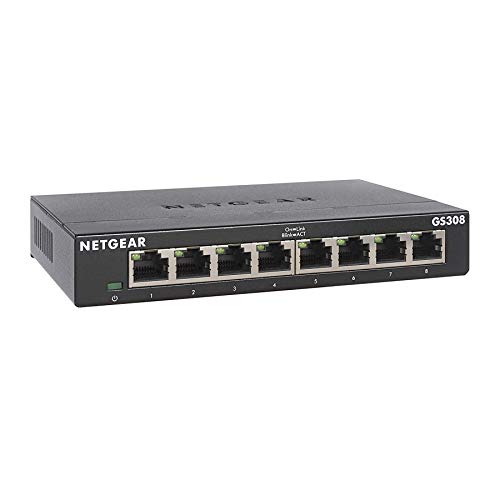
| Best Value | Port Count: 8 ports | Port Speed: Gigabit (1 Gbps) | Management Level: Unmanaged | CHECK LATEST PRICE | Read Our Analysis |
| NETGEAR 8-Port PoE+ Gigabit Easy Smart Switch (GS308EP) |

| Best for PoE Power | Port Count: 8 ports | Port Speed: Gigabit (1 Gbps) | Management Level: Easy Smart (basic managed) | CHECK LATEST PRICE | Read Our Analysis |
| Cisco Business CBS110-8T-D 8-Port Unmanaged GigE Switch |

| Best for Reliability | Port Count: 8 ports | Port Speed: Gigabit (10/100/1000) | Management Level: Unmanaged | CHECK LATEST PRICE | Read Our Analysis |
| NETGEAR GS524 24-Port Gigabit Unmanaged Switch |

| Best for Expansion | Port Count: 24 ports | Port Speed: Gigabit (1 Gbps) | Management Level: Unmanaged | CHECK LATEST PRICE | Read Our Analysis |
More Details on Our Top Picks
NETGEAR GS108 8-Port Gigabit Unmanaged Ethernet Switch
Choose the NETGEAR GS108 if you need a simple, reliable 8‑port Gigabit switch that just works-plug it in, mount it on a desk or wall, and get quiet, energy‑efficient performance without any setup or software. You’ll enjoy eight Gigabit ports with true plug‑and‑play operation, IEEE 802.3az energy efficiency, and a compact chassis that fits tight spaces. It’s intended for U.S. and Canada use, backed by a limited lifetime hardware warranty, next business day replacement, and 24/7 chat support. If you want hassle‑free connectivity for small offices or edge deployments, the GS108 is a practical, durable choice.
- Port Count:8 ports
- Port Speed:Gigabit (1 Gbps)
- Management Level:Unmanaged
- Form Factor / Placement:Desktop or wall-mount
- Energy Efficiency / Standard:Energy Efficient (IEEE 802.3az)
- Warranty / Support:Limited lifetime hardware warranty; next-business-day replacement; 24/7 chat
- Additional Feature:Wall-mountable chassis
- Additional Feature:Quiet fanless operation
- Additional Feature:Designed for U.S./Canada
NETGEAR 8-Port Gigabit Unmanaged Switch (GS308)
If you need a simple, reliable way to add wired ports without fuss, the NETGEAR GS308 delivers eight gigabit RJ45 ports in a compact, fanless metal case-perfect for small offices or quiet workspaces that need plug-and-play expansion with energy-efficient operation. You’ll get unmanaged, no-config setup with auto-MDI/MDI-X and auto-negotiation, non-blocking switching, and LEDs per port so you can monitor connectivity at a glance. It supports desktop or wall mount, complies with IEEE 802.3az for power savings, and runs silently. Dimensions are 6.22×4.02×1.02 inches, powered by 12V DC, with a three-year warranty.
- Port Count:8 ports
- Port Speed:Gigabit (1 Gbps)
- Management Level:Unmanaged
- Form Factor / Placement:Desktop or wall-mount
- Energy Efficiency / Standard:Energy Efficient (IEEE 802.3az)
- Warranty / Support:3-year limited hardware warranty; manufacturer support via customer service
- Additional Feature:Metal rugged case
- Additional Feature:Per-port LED indicators
- Additional Feature:Compact exact dimensions
NETGEAR 8-Port PoE+ Gigabit Easy Smart Switch (GS308EP)
For small offices that need reliable PoE for IP phones or cameras without a lot of fuss, the NETGEAR GS308EP delivers: eight Gigabit ports with PoE+ and a 62W power budget let you power multiple devices while the Easy Smart Managed Essentials interface keeps setup and basic management straightforward. You’ll configure, secure, and monitor traffic with simple menus that cover VLANs, QoS, and basic diagnostics without enterprise complexity. The metal chassis supports desktop or wall-mount placement, so you can position it where it’s most convenient. Backed by a three-year limited hardware warranty, it’s a practical, low-friction PoE+ choice for small deployments.
- Port Count:8 ports
- Port Speed:Gigabit (1 Gbps)
- Management Level:Easy Smart (basic managed)
- Form Factor / Placement:Desktop or wall-mount
- Energy Efficiency / Standard:Energy Efficient (implied; PoE+ model, typical compliance)
- Warranty / Support:3-year limited hardware warranty
- Additional Feature:8 PoE+ ports
- Additional Feature:62W total PoE
- Additional Feature:Easy Smart management
Cisco Business CBS110-8T-D 8-Port Unmanaged GigE Switch
Small offices and retail outlets will appreciate the Cisco Business CBS110-8T-D’s plug-and-play simplicity, since its eight gigabit ports and fanless, compact design let you expand wired connectivity without hiring IT staff. You’ll get true gigabit throughput across eight 10/100/1000 ports in a quiet desktop chassis that’s Energy Efficient Ethernet compliant to reduce power draw. The unmanaged switch requires no configuration, yet includes basic QoS intelligence to prioritize delay-sensitive services. Its small footprint suits storefronts, open-plan offices, and classrooms, and Cisco’s limited-lifetime warranty plus one year of technical support give straightforward peace of mind.
- Port Count:8 ports
- Port Speed:Gigabit (10/100/1000)
- Management Level:Unmanaged
- Form Factor / Placement:Desktop
- Energy Efficiency / Standard:Energy Efficient (IEEE 802.3az)
- Warranty / Support:Limited-lifetime warranty; one year technical support
- Additional Feature:Integrated QoS intelligence
- Additional Feature:Elegant retail-friendly design
- Additional Feature:Return-to-factory replacement
NETGEAR GS524 24-Port Gigabit Unmanaged Switch
The NETGEAR GS524 is ideal for businesses that need reliable, plug-and-play Gigabit connectivity across a mid-sized office or branch, offering 24 full-speed Ethernet ports so you can connect dozens of devices without fuss. You’ll get quiet operation and per-port Gigabit speeds with an energy-efficient design compliant with IEEE 802.3az. Setup’s dead simple-no software or configuration required-and you can place it on a desktop, mount it to a VESA wall plate, or rackmount it. NETGEAR backs it with a Limited Lifetime Hardware Warranty, Next Business Day Replacement, and 24/7 chat support staffed by experts.
- Port Count:24 ports
- Port Speed:Gigabit (1 Gbps)
- Management Level:Unmanaged
- Form Factor / Placement:Desktop / VESA wall mount / rackmount
- Energy Efficiency / Standard:Energy Efficient (IEEE 802.3az)
- Warranty / Support:Limited lifetime hardware warranty; next-business-day replacement; 24/7 chat
- Additional Feature:Rackmount-capable design
- Additional Feature:VESA wall-mount option
- Additional Feature:Next-business-day replacement
Factors to Consider When Choosing Switches for Business
Before you pick a switch, consider how many ports you actually need and whether PoE support is required for phones, cameras, or access points. Decide if you want unmanaged simplicity or a managed switch with VLANs and QoS, and check the performance ratings and port speeds to match your traffic. Also factor in energy-efficiency ratings and power draw to keep operating costs down.
Port Count Needs
Start by tallying every active and planned device – workstations, VoIP phones, printers, APs, CCTV cameras – plus required uplinks, and then add at least 20–30% spare capacity for growth. From that minimum, match port speeds to needs: reserve Gigabit ports for desktops and servers and plan 10Gb uplinks or trunks where multiple Gigabit devices will aggregate heavy traffic. Consider physical topology: place higher‑port switches in wiring closets or aggregation points and use smaller edge switches for deskside or branches to reduce cabling and interswitch links. When you need scalability and redundancy, allocate extra ports for link aggregation, stacking, redundant uplinks and future VLAN segmentation. If you require PoE, verify PoE‑capable port counts and total power budget to support simultaneous device operation.
Power Over Ethernet
Having sorted port counts and uplink plans, you’ll also need to evaluate Power over Ethernet because many modern endpoints draw power from your switches. PoE sends data and power over one Cat5e/Cat6 cable, simplifying IP phone, AP, and camera installs. Match device requirements to standards-802.3af (15.4 W), 802.3at/PoE+ (30 W), and 802.3bt (Type 3: 60 W, Type 4: 100 W). Calculate the switch’s total power budget by summing peak draws and leave headroom for growth. Check per-port limits and how many ports actually support PoE. Prefer switches that offer dynamic allocation or prioritization so critical devices stay online if budget tightens. Finally, factor in added heat: PoE raises thermal load, affecting placement, ventilation, and reliability.
Management Level Options
When you pick a switch, decide how much control and visibility you really need-unmanaged is plug‑and‑play for tiny offices, smart (easy‑managed) adds VLANs and simple QoS for growing shops, and fully managed gives you Layer‑3 routing, SNMP, ACLs and fine‑grained policies for enterprise or multi‑site networks. Choose unmanaged if you want zero setup for a handful of devices. Pick smart switches when you need VLAN segmentation, basic QoS, and a web GUI without high cost. Opt for fully managed when you require advanced VLAN/bridge/STP control, routing, RMON, detailed ACLs and enterprise monitoring. Also match management interfaces-CLI, web GUI, SNMP or REST/API-and confirm logging and monitoring compatibility with your existing tools and operational practices.
Performance And Speed
Because network performance directly affects user experience and application behavior, pick switches that match your bandwidth and latency needs rather than guessing by port count alone. Choose switches with at least 1 Gbps per port for typical office use, and consider 10 Gbps uplinks or server-side ports if you move large files or run virtualization. Check switching capacity (backplane) and forwarding rate to confirm full‑duplex traffic on all ports won’t create bottlenecks. For VoIP and real‑time collaboration, prioritize low‑latency models and QoS to mark and prioritize traffic. Verify PoE total budget and per‑port wattage if you power phones, cameras, or APs. Finally, confirm link aggregation (LACP) support on uplinks to boost throughput and provide redundancy.
Energy Efficiency Standards
If you want to cut operating costs and meet sustainability goals, prioritize switches that comply with IEEE 802.3az and offer advanced power‑management features. You should compare energy-saving functions like port shutoff, cable‑length detection, and dynamic power allocation to reduce idle power draw. Check both maximum and typical wattage and review use‑case power profiles so you can estimate annual energy costs using your local electricity rate and expected utilization. Favor fanless models and high‑efficiency power supplies to lower electrical consumption and cooling overhead. Finally, evaluate PoE and PoE+ power budgets plus per‑port power controls-inefficient PoE delivery can spike total network energy use when you power phones, cameras, or APs.
Physical Deployment Options
Energy savings and power profiles matter, but you also need to plan where and how switches will sit in your workspace. Decide desktop, wall-mount, or rack-mount placement by checking available space and mounting options; remember racks need standard 19-inch depth and may require ears or a tray. Verify dimensions and weight so units fit under desks, in closets, or on walls without blocking airflow or access. Choose fanless for quiet offices and lower thermal budgets; use fan-cooled models where ambient temperatures and density demand active cooling. Plan cabling routes and clearance for RJ45 ports so port orientation and front/rear access support neat management and expansion. Confirm mounting surfaces and nearby power-use proper anchors for wall installations and make certain outlet proximity.
Warranty And Support
When selecting switches, don’t treat warranty and support as optional extras-they directly affect downtime, total cost of ownership, and your ability to recover from failures. Check warranty length and type-limited lifetime vs. fixed-term (e.g., three years)-so you know how long defects and repairs are covered. Verify replacement policy and turnaround: next-business-day swaps, on-site repair, or return-to-factory options will shape expected downtime. Confirm technical support scope and availability-24/7 chat and phone vs. business-hours-and whether advanced support costs extra. Look for clear firmware update and management-software policies to make certain security patches and feature updates continue. Review exclusions like accident, misuse, or aftermarket mods, and whether you can buy extended-care or priority-repair plans.