
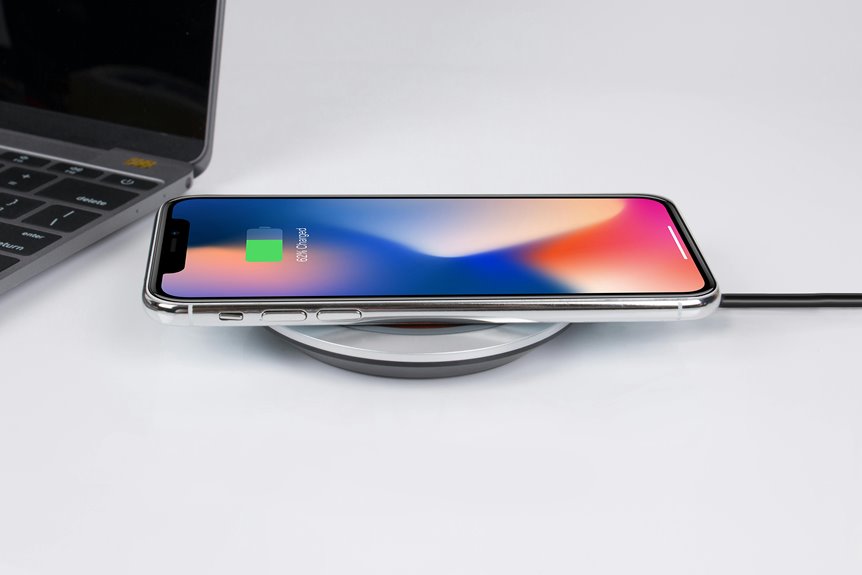
If you place a device on a wireless charging pad, you’re relying on inductive power transfer, not magic. A transmitter turns DC into high-frequency AC, and the resulting magnetic field induces current in a receiver coil. You get convenience, but only when alignment, distance, and resonance stay within tight limits. Standards like Qi help, yet the real constraint is still efficiency under real-world conditions.
What Is Inductive Power Transfer?
Inductive power transfer is a contactless method of moving energy between two coils via electromagnetic induction. You use a transmitter coil to create an alternating magnetic field, and that field induces voltage in a nearby receiver coil. This basic principle links magnetic coupling to energy conversion, turning electrical input at one end into usable electrical output at the other.
You’ll recognize a transformer-like arrangement, except the coils don’t touch. Because the system works in the near field, you get efficient transfer only if the coils stay closely aligned and relatively close together. In practice, this approach lets your devices charge without exposed connectors, while keeping the process technically controlled, precise, and well suited to a community that values reliable, modern power delivery.
How Wireless Charging Moves Energy
Wireless charging moves energy via using alternating current in a transmitter coil to create an oscillating magnetic field, which then induces voltage in a nearby receiver coil through Faraday’s law. You benefit from magnetic field transfer because the field crosses the air gap without a wire, so coil energy coupling replaces direct electrical contact.
As the receiver coil intercepts that changing field, it generates current that your device can convert into usable power. You get the best transfer whenever both coils stay aligned and tuned, because coupling strength and distance directly shape efficiency.
In practice, this near-field process keeps losses low over short ranges, letting you charge confidently and reliably within a shared charging zone. The result is precise, contactless power flow that supports modern mobile devices.
What’s Inside a Wireless Charging System
At its core, a wireless charging system includes a transmitter, a receiver, and control electronics that coordinate power flow between them. In your system architecture, the transmitter’s power electronics convert DC into high-frequency AC, driving a coil that creates the magnetic field. Your receiver coil captures that field, and rectifiers turn the induced AC into usable DC for the battery. Control circuitry monitors alignment, temperature, and load so you’re part of a stable, efficient link.
- You get precise energy transfer without contact.
- You feel confident whenever the coils stay synchronized.
- You belong to a design that prioritizes safety and control.
Together, these blocks form a compact, transformer-like path, and each element matters. Whenever you understand the architecture, you can evaluate losses, efficiency, and integration more rigorously.
Why Wireless Charging Is Gaining Adoption
As device makers push for cleaner industrial designs and lower maintenance, you’re seeing wireless charging gain traction because it removes exposed connectors, tolerates some positional variation, and can deliver efficient power transfer over short gaps. You also benefit from simpler sealing, fewer wear points, and faster product integration into compact enclosures.
In consumer systems, consumer convenience matters: you just place a phone, tool, or accessory on a pad and let the inductive link handle charging. That reduces cable clutter and supports everyday use across shared spaces.
In industrial settings, the same framework improves uptime because contact-free transfer resists dust, vibration, and routine handling. As a result, teams can align around resilient device integration strategies that support safer operation, cleaner aesthetics, and a more unified user experience.
Wireless Charging Standards and Compatibility
Although wireless charging looks universal from the outside, compatibility depends on the foundational standard, operating frequency, coil geometry, and power negotiation protocol. You’ll get reliable charging whenever your device and pad share Qi compatibility, because the standard defines how they detect each other, exchange control data, and regulate delivered power. That shared language supports cross brand interoperability, so you’re not locked into one ecosystem.
- You’ll feel confident choosing certified gear.
- You’ll avoid guesswork whenever matching phones and chargers.
- You’ll join a broader, more seamless charging community.
Whenever you verify certification marks, you reduce setup friction and improve predictability.
In practice, the receiver coil, transmitter coil, and firmware must agree before energy flows, so compatibility is a system-level property, not a marketing claim.
Limits of Inductive Power Transfer
You’ll see that inductive power transfer isn’t lossless, because coil resistance, switching losses, and imperfect coupling reduce delivered power.
You also have to hold the transmitter and receiver in close alignment, since lateral offset and angular misplacement quickly degrade efficiency.
As distance increases beyond the near-field range, the magnetic link weakens sharply, so usable power falls off rapidly.
Efficiency Losses
Even with efficient resonant coupling, wireless charging still loses energy in the transmitter, air gap, and receiver, which limits practical range and power transfer. You can reduce these losses, but you can’t eliminate them because resistance, eddy currents, and switching processes always consume part of the input. Your system’s thermal dissipation rises as current increases, so you need better heat paths and lower-loss materials. Conversion overhead in rectifiers, drivers, and control electronics further cuts net efficiency.
- You gain usable power, but some input always becomes heat.
- You belong to a design target where every watt matters.
- You need tight engineering margins to keep charging reliable.
At higher power, these losses compound, so you should optimize coil Q, semiconductor timing, and shielding carefully.
Alignment Sensitivity
Losses are only part of the limitation; coil alignment also governs how much power actually reaches the receiver. As you tune your system, you’ll see that small shifts in coil positioning change coupling, induced voltage, and charging stability. Your design’s misalignment tolerance sets how forgiving the link feels in real use.
| Factor | Effect |
|---|---|
| Lateral offset | Lowers coupling |
| Angular tilt | Distorts flux |
| Centering | Improves transfer |
| Receiver shift | Adds variance |
| Tolerance window | Defines usability |
You’re part of a group that values predictable performance, so treat alignment as a control variable, not an afterthought. Precise placement keeps the magnetic field concentrated across both coils, helping you maintain efficient transfer without demanding perfect handling every time.
Distance Constraints
As the coil gap grows, the magnetic link weakens quickly, so you can’t treat inductive power transfer like a free-space wireless broadcast.
You need to stay inside tight range thresholds, because efficiency drops as coupling falls and your receiver sees less induced voltage. Most systems work best at a gap tolerance of only millimeters to a few centimeters, with alignment holding the field lines together.
- Stay too far apart, and charging stalls.
- Stay too close, and heat can rise.
- Stay within spec, and you belong to the efficient power path.
You can extend useful distance with resonance, but you’re still bound by near-field physics, coil size, frequency, and load. As you design within these limits, you get predictable charging and a reliable user experience.
Where Wireless Charging Is Headed Next
Wireless charging is heading toward higher power density, greater spatial tolerance, and tighter control over energy delivery.
You’ll see future use cases expand as resonant inductive systems move beyond phones into vehicles, medical implants, robotics, and industrial fleets. Emerging applications will rely on adaptive coils, adaptive power negotiation, and smarter foreign-object detection, so you can charge with less precise alignment and fewer interruptions. As semiconductor efficiency climbs, you’ll get more kilowatts through compact hardware while keeping losses low.
Standards will likely converge on interoperable systems, letting you move between products without changing your habits. For your team, the key shift is clear: wireless power won’t just replace cables; it’ll become an integrated energy layer across connected spaces.
Frequently Asked Questions
How Does Alignment Affect Wireless Charging Efficiency?
Precise coil alignment strengthens magnetic coupling, boosting power transfer and cutting energy loss. When the coils shift off center, efficiency falls fast, even though charging can still happen across a broader gap.
What Frequency Ranges Are Used in Inductive Charging Systems?
Operating frequencies span from below 1 kHz in biomedical systems to 100 to 205 kHz in tightly coupled chargers, and 6.78 MHz in loosely coupled resonant designs; coil resonance and tuning set efficiency and transfer distance.
Which Devices Can Use Inductive Power Transfer Today?
Inductive power transfer is used today in smartphones, electric toothbrushes, wearables, RFID tags, electric vehicles, and medical implants. It supports smartphone charging and medical implant operation, with the added advantages of contactless charging convenience and improved safety.
How Far Can Wireless Charging Work Effectively?
Effective wireless charging usually works only across a practical gap of a few millimeters up to about 10 centimeters, since coupling between the coils weakens fast as distance and misalignment grow.
What Safety Mechanisms Stop Overcharging in Wireless Chargers?
Battery management systems and thermal protection control the process: the charger and device set charging limits, track temperature, and cut power when the battery reaches full charge. This prevents excess charging and keeps the battery safe.