
You want budget clarity and pro performance, yet you shouldn’t have to choose one over the other. As you weigh fast primes, versatile zooms, and long telephotos for 2026, you’ll find lenses that fit different budgets, shooting styles, and lighting conditions-each with trade-offs worth considering. Keep going to see which models deliver the balance you actually need and why they matter for your next shoots.
| Canon EF 50mm f/1.8 STM Lens Black |

| Best Budget Prime | Focal Length: 50mm (prime) | Maximum Aperture: f/1.8 | Mount / System Compatibility: Canon EF (full-frame; also works on APS-C with crop) | VIEW LATEST PRICE | Read Our Analysis |
| Canon RF 24-105mm f/4L Is USM Zoom Lens Black – 2963C002 |

| Versatile Workhorse | Focal Length: 24–105mm (zoom) | Maximum Aperture: constant f/4 | Mount / System Compatibility: Canon RF (EOS R system) | VIEW LATEST PRICE | Read Our Analysis |
| Tamron 28-75mm F/2.8 Di III VXD G2 |

| Portrait Sharpener | Focal Length: 28–75mm (zoom) | Maximum Aperture: constant f/2.8 | Mount / System Compatibility: Sony E (full-frame & APS-C) | VIEW LATEST PRICE | Read Our Analysis |
| Tamron 17-70mm f/2.8 Di III-A VC RXD Lens |

| APS-C All-Rounder | Focal Length: 17–70mm (zoom) | Maximum Aperture: constant f/2.8 | Mount / System Compatibility: Sony E (APS-C) | VIEW LATEST PRICE | Read Our Analysis |
| Canon RF28-70mm F2.8 is STM Macro Black |

| Portable Pro Zoom | Focal Length: 28–70mm (zoom) | Maximum Aperture: constant f/2.8 | Mount / System Compatibility: Canon RF (RF mount) | VIEW LATEST PRICE | Read Our Analysis |
| Canon EF 75-300mm f/4-5.6 III Lens Bundle |
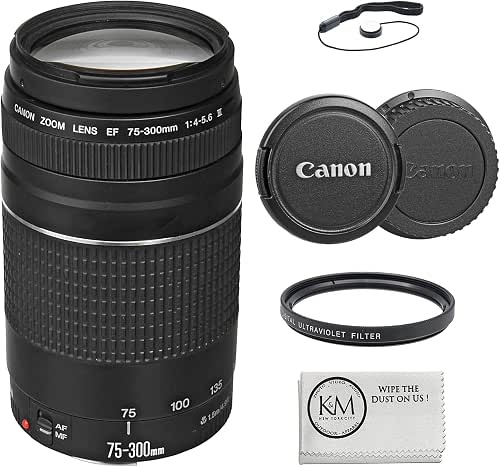
| Telephoto Starter Kit | Focal Length: 75–300mm (zoom) | Maximum Aperture: f/4–5.6 (variable) | Mount / System Compatibility: Canon EF (EF mount) | VIEW LATEST PRICE | Read Our Analysis |
| Canon RF200-800mm F6.3-9 USM Super-Telephoto Zoom Lens |

| Long-Range Specialist | Focal Length: 200–800mm (zoom) | Maximum Aperture: f/6.3–9 (variable) | Mount / System Compatibility: Canon RF (RF mount) | VIEW LATEST PRICE | Read Our Analysis |
More Details on Our Top Picks
Canon EF 50mm f/1.8 STM Lens Black
If you want an affordable, sharp prime that excels for portraits and low-light work, the Canon EF 50mm f/1.8 STM is a top pick-its fast f/1.8 aperture gives you creamy background blur and strong low-light performance, while the STM motor keeps autofocus quiet and smooth for both stills and video. You’ll get classic 50mm framing on full frame and about 80mm on APS-C, useful for headshots and tight portraits. With a 1.15 ft minimum focus and 0.21x magnification, you can get close. Its six elements in five groups and servo AF make it compact, capable, and budget-friendly.
- Focal Length:50mm (prime)
- Maximum Aperture:f/1.8
- Mount / System Compatibility:Canon EF (full-frame; also works on APS-C with crop)
- Autofocus Type / Motor:STM (stepping motor)
- Image Stabilization:No (not specified)
- Build / Weather Resistance:Standard build (no weather sealing specified)
- Additional Feature:Compact six-element design
- Additional Feature:Minimum focus 0.35 m
- Additional Feature:Servo AF for movies
Canon RF 24-105mm f/4L Is USM Zoom Lens Black – 2963C002
The Canon RF 24-105mm f/4L IS USM is a versatile workhorse for photographers who want a single lens that handles landscapes, portraits, and everyday shooting with consistent f/4 performance. You’ll appreciate its compact build for the EOS R system, covering wide-angle to short telephoto without swapping lenses. The constant f/4 aperture and up to 5 stops of optical image stabilization keep handheld shots sharp. Nano USM delivers fast, quiet autofocus, and the customizable control ring gives tactile adjustment. At 1.54 pounds and small dimensions, it’s travel-friendly. Model 2963C002 debuted in 2018 and includes manufacturer warranty details.
- Focal Length:24–105mm (zoom)
- Maximum Aperture:constant f/4
- Mount / System Compatibility:Canon RF (EOS R system)
- Autofocus Type / Motor:Nano USM
- Image Stabilization:Optical IS (up to 5 stops)
- Build / Weather Resistance:L-series build quality (weather/more professional implied)
- Additional Feature:Constant f/4 aperture
- Additional Feature:Built-in control ring
- Additional Feature:Nano USM autofocus
Tamron 28-75mm F/2.8 Di III VXD G2
For photographers who need a compact, fast zoom that performs like a prime, the Tamron 28-75mm F/2.8 Di III VXD G2 delivers edge-to-edge sharpness, silky bokeh, and a constant f/2.8 aperture that’s ideal for low-light shooting and subject isolation. You’ll appreciate its 28–75mm range, 1:2.7 maximum magnification for close-ups, and 7.1-inch minimum focus at the wide end. The VXD linear motor gives fast, quiet autofocus with full Sony E-mount compatibility-Eye AF, Fast Hybrid AF, and in-camera corrections. It’s compact (4.6 in), lightweight (~19 oz), weather-resistant, uses 67mm filters, and carries a 6-year USA warranty.
- Focal Length:28–75mm (zoom)
- Maximum Aperture:constant f/2.8
- Mount / System Compatibility:Sony E (full-frame & APS-C)
- Autofocus Type / Motor:VXD linear motor
- Image Stabilization:No (not specified)
- Build / Weather Resistance:Moisture-Resistant Construction + Fluorine Coating
- Additional Feature:1:2.7 maximum magnification
- Additional Feature:67mm filter thread
- Additional Feature:VXD linear motor
Tamron 17-70mm f/2.8 Di III-A VC RXD Lens
Photographers who shoot on Sony E APS-C bodies will love the Tamron 17-70mm f/2.8 Di III-A VC RXD for its rare combination of fast constant f/2.8 aperture and true 17–70mm range, which gives you a versatile 4.1x zoom that covers wide-angle to short telephoto without swapping lenses. You get outstanding optics from 16 elements in 12 groups, including two GM and a hybrid aspherical element. Upgraded VC and AI-assisted stabilization keep video smooth on Sony APS-C bodies. Close focusing is excellent (7.5″ at 17mm, 15.4″ at 70mm). Weather sealing and a fluorine coating protect the lens.
- Focal Length:17–70mm (zoom)
- Maximum Aperture:constant f/2.8
- Mount / System Compatibility:Sony E (APS-C)
- Autofocus Type / Motor:RXD (rapid eXtra-silent drive) / upgraded VC with AF system
- Image Stabilization:Vibration Compensation (VC) (stabilization)
- Build / Weather Resistance:Moisture-Resistant Construction + Fluorine Coating
- Additional Feature:AI-enhanced video stabilization
- Additional Feature:Two GM aspherical elements
- Additional Feature:4.1x zoom ratio
Canon RF28-70mm F2.8 is STM Macro Black
If you need a fast, versatile everyday zoom that’s surprisingly compact, the Canon RF28-70mm F2.8 fits the bill with its constant f/2.8 aperture and built-in macro capabilities. You’ll appreciate the 28–70mm range for portraits, events, and travel, while the fast aperture gives reliable low-light performance and creamy bokeh. At just 1.59 pounds and compact dimensions, it’s made for carry. A new stabilization unit trims size without sacrificing steadiness. Optical design uses 2 UD and 2 aspheric elements for sharp, L-series-quality results. Weather-resistant build handles rough conditions, and Canon warranty/support backs the 6535C002 model.
- Focal Length:28–70mm (zoom)
- Maximum Aperture:constant f/2.8
- Mount / System Compatibility:Canon RF (RF mount)
- Autofocus Type / Motor:STM
- Image Stabilization:Newly designed Image Stabilization unit (implied)
- Build / Weather Resistance:Weather-resistant construction (L-series equivalent)
- Additional Feature:Macro capability included
- Additional Feature:Two UD elements
- Additional Feature:L-series quality build
Canon EF 75-300mm f/4-5.6 III Lens Bundle
A lightweight telephoto that won’t break your budget, the Canon EF 75-300mm f/4-5.6 III bundle is ideal for hobbyists and travel shooters who need reach without carrying heavy glass. You get the telephoto EF-mount lens for full-frame bodies, a 58mm UV filter, a Lens Cap Keeper, and a microfiber cleaning cloth, plus manufacturer-supplied caps. The lens covers f/4 to f/45, uses a DC micro motor AF, a 7-blade diaphragm, and Super Spectra coating for reduced flare. It fits Canon EF cameras only (not EOS R/RF), includes a limited 1-year warranty, and suits budget-minded telephoto needs.
- Focal Length:75–300mm (zoom)
- Maximum Aperture:f/4–5.6 (variable)
- Mount / System Compatibility:Canon EF (EF mount)
- Autofocus Type / Motor:DC Micro Motor
- Image Stabilization:No (not specified)
- Build / Weather Resistance:Standard consumer build (no weather sealing specified)
- Additional Feature:Includes 58mm UV filter
- Additional Feature:Super Spectra coating
- Additional Feature:Seven-blade diaphragm
Canon RF200-800mm F6.3-9 USM Super-Telephoto Zoom Lens
For those who chase distant action or wildlife without lugging a full rig, the Canon RF200-800mm F6.3-9 USM delivers an extraordinary 200–800mm reach in a surprisingly compact, handheld-friendly package. You get true super-telephoto power in a roughly 4.5-pound, 12.4 x 4 x 4-inch body that’s built for mobility. Integrated IS provides up to 5.5 stops of shake correction, and the USM motor gives fast, quiet autofocus. It works with RF Extender 1.4x and 2x at all focal lengths, preserving versatility across wildlife, birding, and outdoor sports. Model 6263C002 shipped November 2, 2023, with Canon USA support.
- Focal Length:200–800mm (zoom)
- Maximum Aperture:f/6.3–9 (variable)
- Mount / System Compatibility:Canon RF (RF mount)
- Autofocus Type / Motor:USM (Ultrasonic Motor)
- Image Stabilization:Integrated IS (up to 5.5 stops)
- Build / Weather Resistance:Professional-grade design (weather-resistant implied; built for outdoor use)
- Additional Feature:Compatible with RF extenders
- Additional Feature:5.5-stop IS effectiveness
- Additional Feature:World’s first 800mm AF zoom
Factors to Consider When Choosing Camera Lenses
When choosing a lens, you should match focal length to the subjects you shoot and balance aperture needs for low-light and depth-of-field control. Consider image stabilization and autofocus speed for handheld and action work, and check build quality and weather sealing for durability. These factors will help you pick a lens that performs where and how you shoot.
Focal Length Needs
How close do you need to get to your subject? Decide that first, because focal length controls angle of view and magnification. If you shoot landscapes, architecture, or interiors, choose wide-angle lenses (below 35mm) to capture expansive scenes. For everyday shooting, a standard ~50mm on full-frame gives a natural perspective that mimics the eye, making it versatile for portraits and street work. When subjects are distant-wildlife, sports-telephoto glass (above 100mm) lets you frame tightly without approaching. Consider primes for specific focal lengths: they often yield sharper images and tend to outperform zooms in image quality. Match focal length to subject distance and framing needs so your lens choice supports composition, working distance, and the story you want to tell.
Maximum Aperture Importance
Although you might prioritize focal length first, maximum aperture deserves equal attention because it directly affects light-gathering, depth of field, and working flexibility. You’ll notice that a larger maximum aperture (a smaller f-number like f/1.8 or f/2.8) lets more light reach the sensor, which helps in low-light scenes and lets you use faster shutter speeds. It also creates a shallower depth of field for strong subject separation, ideal for portraits. Choose lenses with a constant maximum aperture across the zoom range if you want consistent exposure and predictable performance when you change focal length. Remember that wide-aperture designs usually improve autofocus in dim conditions but tend to be bigger and heavier due to larger optical elements.
Image Stabilization Benefits
Because camera shake becomes more noticeable as focal length increases, effective image stabilization lets you handhold shots you otherwise couldn’t-often up to about 5 stops slower shutter speeds-so you can shoot sharp telephoto and zoom images without a tripod. IS reduces blur from camera movement, which matters most when you’re at long focal lengths or in low light. It also stabilizes video, giving smoother footage and fewer jitters while you move. When choosing lenses, prioritize models with proven vibration compensation if you shoot handheld or film run-and-gun clips. Keep in mind IS complements good technique and modern autofocus, improving overall clarity, but don’t rely on it to fix extreme motion or subject blur from fast action.
Autofocus Performance Expectations
When you pick a lens, autofocus performance should be high on your checklist since it directly affects sharpness, tracking, and the speed at which you can capture decisive moments. You’ll want motors like STM, USM, or advanced linear types for near-silent, quick, precise focusing that suits both stills and video. For action, wildlife, or sports, prioritize lenses with fast, smooth AF and reliable continuous or servo modes to hold moving subjects. Make sure the lens fully supports your camera’s AF tech-Eye AF, Fast Hybrid AF, etc.-so tracking and accuracy are optimized. Also look for customization options and firmware updates that let you tweak AF behavior and maintain peak performance as systems evolve.
Build And Weatherproofing
If you plan to shoot outdoors or in challenging conditions, choose lenses with solid construction and thorough weather sealing to keep moisture, dust, and grime out of the optics and mechanics. You’ll want metal mounts and robust housings for durability and reliable mechanical performance under frequent use. Check for moisture sealing at the mount, switches, and zoom or focus rings to prevent internal damage. Prefer lenses rated to operate across wide temperature ranges so they won’t falter when conditions change. Fluorine coatings on elements and exterior surfaces are a big help – they repel water, oil, and dirt, making cleaning easier and preserving image quality. Prioritize build and weatherproofing to protect your investment and maintain consistent operation outdoors.
Frequently Asked Questions
Do Lens Warranties Vary by Country or Retailer?
Yes – warranties can vary by country and retailer. You’ll find differing coverage lengths, transferability, and service options; some retailers add extended plans while manufacturers’ international warranties may be limited, so always check terms before buying.
How Do Weather-Sealing Ratings Compare Between Brands?
They’re similar in purpose but vary in execution: you’ll find equivalent dust/magnesium sealing across brands, yet some makers add better gaskets or port covers-so you’ll compare specs, IP ratings if given, and real-world tests before buying.
Can I Rent High-End Lenses Before Purchasing?
Yes – you can rent high-end lenses before buying, and it’s smart to test optics, handling, and fit. You’ll compare performance, confirm compatibility, and avoid costly mismatches; just check rental insurance and return policies.
What Maintenance Schedule Should I Follow for Long-Term Care?
You should clean lenses after every shoot, inspect seals and mounts monthly, lubricate moving parts yearly, store in a dry, padded case with desiccant, service professionally every 2–3 years, and avoid extreme temperatures or impact.
Are Third-Party Lens Adapters Reliable for Autofocus?
Like a bridge over water, yes-some third-party adapters reliably support autofocus, but you’ll want to check model compatibility, firmware updates, and reviews; occasional quirks happen, so test before important shoots and keep firmware current.