
You might wonder whether small nearfield monitors can really give you the clarity pros need. If you’re chasing mixes that translate, the right 3.5–4″ woofer, refined tweeter, and useful room-tuning matter more than brand hype. I’ll walk you through five reliable options that balance accuracy, connectivity, and low-end control so you can hear problems, not flattering coloration-keep going to compare features that actually affect your workflow.
| Edifier MR4 4″ Powered Studio Monitor Speakers (White) |
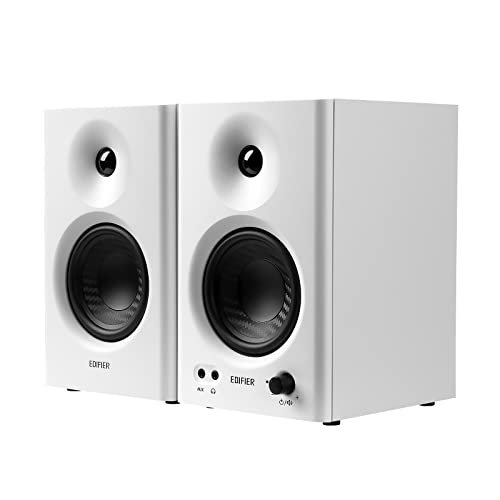
| Best for Accurate Mixing | Active / Powered: Powered (active near-field monitors) | Tweeter Type / High‑Freq Driver: 1″ silk dome tweeter | Woofer / Low‑Freq Driver Size: 4″ composite woofer | VIEW LATEST PRICE | Read Our Analysis |
| ADAM Audio T5V Studio Monitor (Single) |

| Detail-Oriented Choice | Active / Powered: Powered (active studio monitor, single) | Tweeter Type / High‑Freq Driver: U-ART ribbon tweeter | Woofer / Low‑Freq Driver Size: (built-in) woofer with bass-reflex port (size not specified) | VIEW LATEST PRICE | Read Our Analysis |
| Ortizan C7 Dual-Mode 2.0 Bluetooth Studio Monitor Speakers |

| Best for Desktop Flexibility | Active / Powered: Active (powered 2.0 studio monitors, pair) | Tweeter Type / High‑Freq Driver: 0.75″ silk dome tweeter | Woofer / Low‑Freq Driver Size: 3.5″ carbon-fiber woofer/mid-bass | VIEW LATEST PRICE | Read Our Analysis |
| ADAM Audio A4V 4-inch Powered Studio Monitor |

| Professional Precision | Active / Powered: Powered (2-way powered nearfield monitor) | Tweeter Type / High‑Freq Driver: X-ART accelerated-ribbon tweeter | Woofer / Low‑Freq Driver Size: 4″ long-excursion woofer | VIEW LATEST PRICE | Read Our Analysis |
| Edifier MR3 Hi-Res Bluetooth Powered Studio Monitor Speakers |

| Best for Hi‑Res Listening | Active / Powered: Powered (active studio/monitor speakers, pair) | Tweeter Type / High‑Freq Driver: 1″ tweeter (Hi-Res certified) | Woofer / Low‑Freq Driver Size: 3.5″ mid-low driver (per speaker) | VIEW LATEST PRICE | Read Our Analysis |
More Details on Our Top Picks
Edifier MR4 4″ Powered Studio Monitor Speakers (White)
If you need accurate near-field monitoring for mixing or tracking without breaking the bank, the Edifier MR4s give you a near-flat response and dedicated HF/LF controls so you can hear and tweak details with confidence. You’ll get 4″ composite woofers and 1″ silk dome tweeters in MDF cabinets that cut resonance and reveal accuracy. Front-panel volume, mode, and HF/LF knobs let you switch between monitor and music modes quickly. Hook up via balanced TRS, RCA, or AUX, and use the front headphone jack for private checks. They’re wired, powered, bookshelf-friendly, and built for studio use.
- Active / Powered:Powered (active near-field monitors)
- Tweeter Type / High‑Freq Driver:1″ silk dome tweeter
- Woofer / Low‑Freq Driver Size:4″ composite woofer
- Near‑field / Desktop Use:Near-field studio monitoring (bookshelf)
- Multiple Input Options (Wired):TRS (1/4″ balanced), RCA, AUX
- Indoor / Non‑waterproof:Indoor use; not water resistant / not waterproof
- Additional Feature:Dual HF/LF knobs
- Additional Feature:Monitor/music modes
- Additional Feature:Front headphone output
ADAM Audio T5V Studio Monitor (Single)
Choose the ADAM Audio T5V when you want a compact monitor that punches well above its size-its U-ART ribbon tweeter and HPS waveguide deliver revealing highs and precise dispersion, making it ideal for music creation, podcast editing, and small-room mixing. You’ll get extended low end from the built-in woofer and rear-firing bass-reflex port, and you can add the T10S subwoofer for deeper monitoring. The beveled cabinet and compact footprint let you place it flexibly in tight rooms, while high- and low-shelf DSP filters tame problematic acoustics. Multiple analog inputs mean easy integration with interfaces and plug-and-play operation.
- Active / Powered:Powered (active studio monitor, single)
- Tweeter Type / High‑Freq Driver:U-ART ribbon tweeter
- Woofer / Low‑Freq Driver Size:(built-in) woofer with bass-reflex port (size not specified)
- Near‑field / Desktop Use:Designed for near-field recording/producing (studio)
- Multiple Input Options (Wired):Multiple analog inputs (various wired inputs)
- Indoor / Non‑waterproof:Studio/indoor use (not waterproof)
- Additional Feature:U-ART ribbon tweeter
- Additional Feature:Rear bass-reflex port
- Additional Feature:DSP shelf filters
Ortizan C7 Dual-Mode 2.0 Bluetooth Studio Monitor Speakers
The Ortizan C7 Dual-Mode 2.0 monitors suit producers and content creators who need compact, flat-response speakers with modern connectivity; their built-in 24-bit USB DAC and Bluetooth 5.3 let you switch seamlessly between precise near-field monitoring and casual wireless listening. You’ll get a pair of minimalist white monitors with 3.5″ carbon-fiber woofers and 0.75″ silk-dome tweeters, a 2-way crossover, and a balanced 6.35mm TRS plus RCA, USB, and AUX inputs. Front-panel headphone output and touch controls simplify workflows. At 5–8 inches each, they’re desktop- and stand-friendly for mixing, gaming, TV monitoring, and content creation.
- Active / Powered:Active (powered 2.0 studio monitors, pair)
- Tweeter Type / High‑Freq Driver:0.75″ silk dome tweeter
- Woofer / Low‑Freq Driver Size:3.5″ carbon-fiber woofer/mid-bass
- Near‑field / Desktop Use:Near-field monitoring, desktop/stand
- Multiple Input Options (Wired):USB, RCA, 3.5mm AUX, 6.35mm TRS (balanced)
- Indoor / Non‑waterproof:Indoor use; waterproof: False
- Additional Feature:Built-in 24-bit USB DAC
- Additional Feature:Bluetooth 5.3 wireless
- Additional Feature:Touch front controls
ADAM Audio A4V 4-inch Powered Studio Monitor
Targeted at project studios and nearfield mixing, the ADAM Audio A4V puts a rotatable X-ART ribbon tweeter and a 4-inch long-excursion MLM woofer into a compact, DSP-tuned package so you get surgically precise highs and tight low-mid definition on a tabletop or monitor stand. You’ll benefit from 54 Hz–42 kHz bandwidth, 96 kHz/24-bit conversion and per-speaker DSP tuning that refines imaging and response in small rooms. The compact, rectangular black cabinet (8.63″ D x 6.25″ W x 10.5″ H) weighs about 16.8 lb, runs on corded power, accepts wired inputs from most devices, and is controlled via ADAM’s app.
- Active / Powered:Powered (2-way powered nearfield monitor)
- Tweeter Type / High‑Freq Driver:X-ART accelerated-ribbon tweeter
- Woofer / Low‑Freq Driver Size:4″ long-excursion woofer
- Near‑field / Desktop Use:Nearfield studio monitor (tabletop/stand)
- Multiple Input Options (Wired):Wired audio inputs (standard studio connections)
- Indoor / Non‑waterproof:Indoor use; not waterproof / not water resistant
- Additional Feature:Rotatable X-ART tweeter
- Additional Feature:96 kHz DSP conversion
- Additional Feature:Vertical imaging optimization
Edifier MR3 Hi-Res Bluetooth Powered Studio Monitor Speakers
If you need accurate near‑field monitoring with modern wireless convenience, the Edifier MR3 pairs Hi‑Res certification and a flat 52 Hz–40 kHz response with Bluetooth 5.4 and balanced TRS/RCA inputs so you can track, mix, or stream from almost any source. You get a 2.0 active pair with 3.5″ woofers and 1″ tweeters in MDF cabinets, 18 W×2 RMS output, 92.5 dB peak SPL, and an 85 dB SNR for clean playback. The EDIFIER ConneX app lets you switch Music, Monitor, or Custom modes and tweak EQ. Headphone out, multi‑point Bluetooth, and multi‑room support add practical studio flexibility.
- Active / Powered:Powered (active studio/monitor speakers, pair)
- Tweeter Type / High‑Freq Driver:1″ tweeter (Hi-Res certified)
- Woofer / Low‑Freq Driver Size:3.5″ mid-low driver (per speaker)
- Near‑field / Desktop Use:Near-field monitoring, home studio
- Multiple Input Options (Wired):TRS (balanced), RCA, AUX
- Indoor / Non‑waterproof:Indoor use; waterproof: False
- Additional Feature:Hi-Res Audio certified
- Additional Feature:Bluetooth v5.4 multipoint
- Additional Feature:EDIFIER ConneX app
Factors to Consider When Choosing Professional Studio Audio Monitors
When choosing studio monitors, you’ll want to check frequency response balance and pick the driver type that suits your work. Consider room acoustic treatment and whether the monitors’ connectivity and I/O match your setup. Also look for on-board DSP controls to fine-tune performance for your room.
Frequency Response Balance
A near-flat frequency response is the cornerstone of accurate monitoring, so you’ll want speakers that reproduce roughly 20 Hz–20 kHz without large colorations. Aim for controlled low-frequency extension with a clear roll-off-small nearfield monitors usable to roughly 50–60 Hz help prevent misleading bass. Check smooth on-axis and near-field off-axis responses; peaks or dips exceeding ±3 dB will bias your perception during mixing. Make certain the tweeter delivers detail up to at least 20 kHz with predictable dispersion to preserve spatial cues and high-end clarity. Prefer monitors with modest HF/LF or shelving controls that allow ±1–3 dB compensation for room anomalies rather than large boosts that could mask true tonal problems.
Driver Type Selection
Pick drivers that match the monitoring tasks you’ll be doing, because choice of tweeter, woofer size, and enclosure type directly shapes accuracy, transient response, and bass extension. For nearfield work you’ll often choose dynamic cone woofers with dome tweeters-reliable power handling and compact 3.5″–4″ woofers give tight bass but limited absolute low end. If you need ultra-fast transients and airy highs, consider ribbon or air‑motion tweeters; they extend past 40 kHz and sharpen imaging. Decide between two‑way or three‑way layouts: two‑ways keep crossover complexity low, while three‑ways add a mid driver for clearer midrange separation. Match cone materials and cabinet coupling for linearity and low resonance, and weigh driver excursion plus sealed versus bass‑reflex behavior against your bass requirements.
Room Acoustic Treatment
With your monitors in the room, treat early reflections, room modes, and overall reverberation so the speakers can reveal accurate detail. Control first-reflection points from side walls, floor, and ceiling within ~20–80 ms using absorption or angled surfaces to preserve direct sound. Measure room modes with a sweep; address axial and tangential bass buildup or nulls below ~300 Hz with corner and wall-floor junction bass traps. Aim for an RT60 around 0.3–0.5 seconds in small control rooms to keep mixes clear without sounding dead. Maintain left-right symmetry in treatment and sit the listening position near 38% of room length to reduce modal imbalance. Combine porous absorption and bass traps with diffusion (quadratic or skyline) to retain natural ambience.
Connectivity And I/O
Because your monitors are only as useful as the way they connect, prioritize versatile I/O that matches both pro gear and consumer sources. Make certain monitors offer both balanced (XLR or 1/4″ TRS) and unbalanced (RCA or 3.5mm) inputs so you can plug in an audio interface or a phone without adapters. Use balanced inputs for studio runs to reduce hum and preserve dynamic range. Check for a front-panel headphone output with its own level control for private listening and quick cueing. If you work directly from a computer, choose monitors with digital inputs (USB or S/PDIF) or a built-in DAC for higher-resolution conversion. Finally, confirm presence of HF/LF EQ switches and physical trim pots to adapt response to your room and placement.
On-Board DSP Controls
Consider on-board DSP the smart bridge between your monitors and your room: it gives you parametric and shelving filters, time-alignment, and preset compensation so you can tame boundary gain, standing waves, and driver-phase issues without adding external gear. You’ll use adjustable high/low-shelf and notch filters to fix placement-induced frequency bumps, and selectable voicing modes or HF/LF trims to switch between flat monitoring and consumer‑targeted balances. DSP time-alignment and FIR/IIR crossover processing aligns woofer and tweeter outputs for a coherent impulse response and fewer phase anomalies. Look for multiple user presets and boundary profiles (wall, corner, stand) so one pair adapts to setups. Finally, check DSP specs-sample rate, bit depth, filter Q/resolution-and whether controls live on the monitor, in a desktop app, or via presets for your workflow.
Placement And Imaging
Placed and aimed correctly, your monitors will give you a tight stereo image, accurate depth cues, and a reliable sweet spot you can trust for critical work. Place nearfield monitors so the tweeters and your head form an equilateral triangle-about 60° apart-to center the image. Set tweeters roughly at ear height when seated and toe them in slightly so high-frequency dispersion hits you directly. Keep monitors 1–2 feet from side and rear walls and out of corners to avoid boundary reflections and bass buildup; verify with measurements or room treatment. Mirror placement left-to-right and relative to room features to prevent lateral coloration. Isolate monitors on stands or decouplers and tweak vertical and horizontal positions while listening to reference tracks until imaging sharpness and depth feel right.