

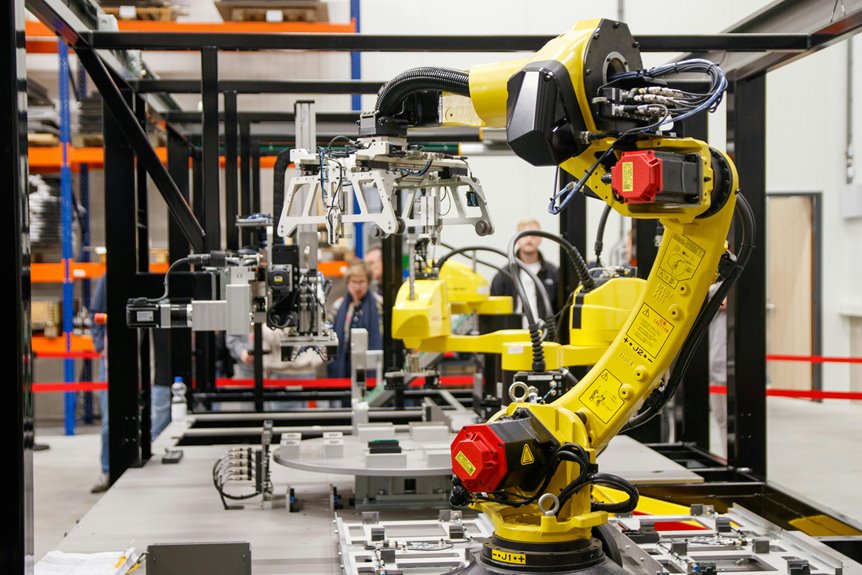
Nearly 3.4 million industrial robots now operate worldwide, and you’re seeing only the start of that shift. You rely on robotic systems when speed, repeatability, and traceability matter in assembly, welding, inspection, and material flow. These machines sense, decide, and act through coordinated hardware and software, but their real value emerges when you inspect how they’re integrated—and where they still fall short.
What Robotics Systems Are
Robotic automation systems are integrated machine setups that use robots to streamline manufacturing through automating repetitive tasks such as assembly, welding, material handling, and quality control.
You can view them as engineered workcells that reduce manual touchpoints and stabilize output.
Robotic arms, articulated units, and cobots fit into automated production lines through robotic integrators who align motion, tooling, and cycle timing with your process goals.
You benefit from minimal intervention, because the system executes repeatable operations with consistent precision and lower error rates.
These platforms suit industries that need high throughput, such as plastics and discrete manufacturing, while helping you work within a modern, collaborative production community.
In practice, they create a controlled, measurable environment that supports reliable manufacturing performance.
How Robotics Sense and Respond
Robotics sense and respond through layered sensors, control software, and programmed safety logic that continuously monitor the workcell and adjust robot motion in real time. You see sensor fusion combine distance, force, and vision inputs into one reliable state model, so the system can make an adaptive response without hesitation.
| Input | Signal | Action |
|---|---|---|
| Proximity | Rising | Slow |
| Force | Spike | Stop |
| Vision | Clear | Continue |
You work with a platform that classifies conditions, prioritizes safety, and updates trajectories within milliseconds. Whenever a person enters range or a part shifts, the controller recalculates paths, preserves throughput, and keeps your team aligned with predictable, repeatable automation. This feedback loop helps you trust the cell, because it reacts consistently while protecting people and product quality.
Core Parts of a Robotics System
You can break a robotics system into three core elements: the robot structure, sensors and input, and control systems.
The structure provides the mechanical frame and motion axes, sensors capture operational and environmental data, and input devices transmit that data to the controller.
The control system processes the inputs and issues precise commands that coordinate movement, timing, and task execution.
Robot Structure
At the heart of an automated machine system, the robot structure defines how force, motion, and control are organized to execute tasks with precision. You can view it as your platform for reliable automation, where robot chassis design sets rigidity, balance, and load paths, while joint actuator systems convert commands into repeatable movement. In your cell, each element works together to sustain accuracy under continuous production.
1. Base: anchors stability. 2. Links: transfer force. 3. Joints: enable controlled degrees of freedom. 4. End effector mount: supports task-specific tools.
Upon you understand this architecture, you belong to a system built for consistency, scalability, and minimal downtime, because the structure itself governs performance, durability, and integration across demanding industrial workflows.
Sensors and Input
In your cell, input signal processing filters noise, normalizes signals, and timestamps events so the system can interpret fast-changing conditions accurately. With sensor fusion basics, you combine multiple readings to improve confidence and reduce false detections, which helps your team maintain reliable throughput.
You also benefit from calibrated inputs that support safer collaboration, tighter tolerances, and more consistent quality. As your sensors stay aligned and responsive, your automated line feels cohesive, predictable, and ready for demanding production goals.
Control Systems
Once sensor data is filtered and normalized, control systems turn that information into motion, timing, and force commands that keep a robotic machine system on target. You rely on them to coordinate motion control loops, compare setpoints, and correct drift in real time.
In your cell, they:
- regulate axis speed and position
- adjust torque for safe gripping
- synchronize conveyors, arms, and end tools
- apply feedback signal tuning to reduce overshoot
This closed-loop logic helps you maintain repeatability, protect equipment, and meet cycle-time goals without constant oversight. Whenever you belong to a well-tuned automation team, you see faster changeovers, steadier quality, and fewer faults. Strong control systems make your robots predictable, adaptable, and ready for continuous production.
Main Types of Robotics Today
You’ll typically encounter two primary robotics types in automated machine systems: industrial robot arms and autonomous mobile robots.
Industrial robot arms execute fixed-position tasks such as assembly, welding, and inspection with high repeatability, while autonomous mobile robots transport materials across production and warehouse environments without direct human guidance.
Together, they improve throughput, reduce handling errors, and support flexible, scalable automation.
Industrial Robot Arms
- High repeatability
- Fast cycle times
- Simple reprogramming
- Safer task isolation
You’ll fit these systems into familiar production teams because they integrate with controllers, sensors, and guarding.
As you tune motion profiles and maintenance intervals, you get dependable throughput, stronger quality control, and a shared standard of precision across your operation.
Autonomous Mobile Robots
You can deploy them for warehouse routing, pallet transport, and line replenishment, and they’ll replan around congestion, blocked aisles, and changing demand.
With fleet routing software, you coordinate multiple robots as a unified system, improving throughput and reducing idle travel.
AMRs fit into your operation without major infrastructure changes, so you can scale capacity quickly and keep your team aligned around safer, more predictable material flow.
Their precision lowers handling errors, while 24/7 operation supports continuous production.
As part of your robotics ecosystem, AMRs strengthen efficiency, flexibility, and workplace belonging.
How Robotics Automate Repetitive Work
Via automating repetitive work, robotic systems take over high-frequency tasks such as assembly, welding, material handling, and quality inspection with consistent speed and precision. You gain process optimization because each cycle runs the same way, reducing variation and defects. On task repetition, robots don’t drift, tire, or need breaks, so you can keep output stable and predictable.
- You improve throughput.
- You lower error rates.
- You cut downtime.
- You strengthen repeatability.
When you integrate automation into your line, you join a team that values measurable control, shared standards, and reliable results. Robots execute programmed motions with exact timing, so you can redirect human effort toward oversight, improvement, and higher-value decisions. That balance helps your operation stay efficient, disciplined, and competitive.
Manufacturing and Warehouse Robotics
As those repetitive tasks become automated, manufacturing and warehouse robotics expand that precision across entire production and logistics workflows.
You can deploy articulated arms for assembly, welding, screwdriving, and leak testing, while collaborative robots work beside your team with sensors that slow or stop on contact.
In warehouses, autonomous fleets handle picking, sorting, and material transport with minimal intervention, improving warehouse throughput optimization and reducing downtime.
You can integrate robotic cells with production lines through robotic integrators, then reprogram them quickly as SKU demand shifts.
For storage and outbound flow, pallet flow automation keeps loads moving predictably, cuts handling errors, and supports continuous operation.
Together, these systems enhance consistency, safety, and scalability, so you belong to a process environment built for speed and control.
Robotics in Healthcare and Surgery
In healthcare and surgery, robotic systems extend automation into environments where precision, consistency, and safety are critical. You rely on them to support minimally invasive procedures, instrument positioning, and sterile handling. Surgical robot precision improves dexterity, filtering tremor and scaling motion so you can operate with tighter control. Hospital automation workflow also benefits, because robots can transport supplies, manage instruments, and reduce delays between stages.
- You get repeatable motion.
- You reduce exposure to infection risks.
- You improve procedural efficiency.
- You support team coordination.
Analytically, these systems work best once you integrate imaging, sensors, and clinical supervision. That combination helps you belong to a care model that values accuracy, accountability, and safer results without replacing expert judgment.
Home Robotics for Everyday Tasks
You can use home robotics to automate daily chores such as vacuuming, floor cleaning, and laundry sorting with consistent repeatability.
Smart home assistants can coordinate devices, execute scheduled routines, and adapt task execution based on sensor inputs and user commands.
Safety and monitoring functions let you track conditions, detect anomalies, and trigger alerts or shutdowns whenever the system identifies a risk.
Daily Chore Automation
Home robotics can automate routine household chores via using sensors, programmable routines, and task-specific end effectors to handle cleaning, tidying, and basic maintenance with minimal oversight. You can assign systems to work predictably, so your home stays organized and your time stays yours. These platforms support:
- Floor vacuuming and spot cleanup
- Laundry folding with vision-guided manipulators
- Pet care automation for feeding and litter tasks
- Surface wiping and object sorting
You’ll benefit from repeatable execution, reduced physical strain, and fewer missed chores. Whenever robots map rooms, detect obstacles, and adapt grasping force, they perform reliably in shared spaces. That consistency helps you feel supported, not isolated, because your household routines start aligning with a practical, tech-enabled rhythm.
Smart Home Assistance
As daily chore automation matures, smart home assistance extends robotics from routine cleanup to broader everyday support across the house. You can use mobile robots and compact manipulators to fetch objects, organize rooms, and coordinate voice activated routines with lights, appliances, and media.
These systems rely on mapping, object recognition, and task scheduling, so they respond predictably to your preferences. You stay in control through simple interfaces, while the robot handles repetitive actions with consistent precision. In a connected home, you gain time, reduce effort, and feel part of a smoother daily flow.
For families, elderly companionship features can offer conversational interaction, notices, and gentle presence, helping the home feel more responsive and inclusive without adding complexity or friction.
Safety And Monitoring
While home robots take on more tasks, safety and monitoring become essential to keep them reliable around people, pets, and property. You should treat every unit like a networked machine system with active supervision.
- Verify obstacle detection, force limits, and emergency-stop response before each run.
- Review camera, lidar, and proximity logs to catch drift or blind spots.
- Use remote diagnostics to isolate faults fast, without delaying your routine.
- Apply predictive maintenance so wear, battery loss, and actuator strain get addressed promptly.
When you track alerts and performance trends, you belong to a safer, more capable home automation setup. Your robot can then adapt cleanly, reduce risk, and stay dependable across daily cycles. Regular updates and secure access controls also keep you in control while shared spaces stay protected.
Robotics in Exploration and Hazardous Jobs
Robotic systems are especially useful in exploration and hazardous jobs because they can reach environments that are too dangerous, unstable, or inaccessible for people. You can deploy space exploration robotics to survey planetary terrain, collect samples, and transmit measurements without risking crew exposure.
In mines, reactors, and offshore facilities, hazardous environment inspection robots map structures, detect leaks, and assess damage in confined zones. You gain reliable data from sensors, cameras, and manipulators that operate where human entry would be impractical.
These systems help you support mission teams, reduce uncertainty, and maintain operational continuity. Whenever you integrate them into your workflow, you join a practice that values careful analysis, shared resilience, and responsible action in extreme conditions.
Speed, Precision, and Safety Benefits
If you deploy robotic automation systems, you increase production speed, precision, and safety at the same time. You can count on high speed production while keeping cycle times stable and repeatable. Your line gains measurable control because robots execute programmed motions with exact tolerances, supporting precision quality control across every unit.
- Faster throughput with fewer pauses
- Repeatable motion that cuts variation
- Sensor-based stops that protect teams
- Consistent inspection without fatigue
You belong to a workflow that values data-driven performance, not guesswork. By automating repetitive tasks, you reduce human exposure to hazards and let your operators focus on supervision, analysis, and improvement.
The result is a tighter process, cleaner output, and a safer, more synchronized production environment.
Current Limits in Cost, Flexibility, and Safety
You still face significant capital costs when you deploy robotic automation, including integration, tooling, and maintenance.
Even when you reprogram systems quickly, you can’t always preserve flexibility across varied SKUs, process changes, and edge cases.
Safety controls lower risk, but they don’t eliminate hazards, so you need strict guarding, sensing, and operational oversight.
Cost Barriers
Despite their productivity gains, automated machine systems still face cost barriers that can slow adoption, especially for smaller operations. You need substantial startup capital for robots, integration, controls, and line calibration. Ongoing maintenance expenses also affect total cost of ownership, and you’ll want to budget for parts, diagnostics, and technician support.
- Upfront acquisition can exceed manual tooling.
- Integration often requires custom engineering.
- Training adds indirect labor cost.
- Payback depends on volume and uptime.
If you’re comparing options, analyze lifecycle cost, not purchase price alone. You belong in the group that treats automation as a measured investment: one that can raise throughput, but only if your process scale justifies the financial commitment.
Flexibility And Safety Limits
Although robotic automation systems can reprogram quickly and scale across production lines, they still have practical limits in flexibility and safety that you can’t ignore. You could add axes, sensors, and software, but each change still needs validation, integration time, and operator training.
In high-mix environments, you’ll hit constraints whenever grippers, reach envelopes, or vision models can’t handle every variant cleanly. Safety adds further boundaries: collaborative robots still demand clear human robot boundaries, guarded zones, and disciplined emergency stop protocols.
When you push throughput too hard, response times, sensing coverage, and collision margins can degrade. You’re part of a team that must balance adaptability with risk control, because automation performs best whenever its limits are engineered, documented, and respected.
How AI Is Improving Robotics
AI is making robotic systems smarter, faster, and more adaptable through improving perception, decision-making, and task execution in real time. You can see this as machine vision identifies parts, motion models refine paths, and control loops adjust instantly.
- Predictive maintenance spots wear before faults disrupt your line.
- Adaptive coordination lets robots share space and synchronize actions.
- Learning algorithms tune grasping, welding, and inspection with fewer errors.
- Sensor fusion improves awareness, so you get safer, tighter handling.
This intelligence helps your automated machine systems respond to variation without losing throughput. You gain consistent quality, faster cycle times, and better uptime because the robot doesn’t just repeat commands—it interprets setting. As AI evolves, your team can rely on robotics that act more like capable partners, fitting smoothly into high-demand production environments.
Cost, Integration, and Workforce Readiness
Smarter robotic systems only deliver value whenever you account for cost, integration, and workforce readiness. You should model acquisition, installation, programming, and maintenance costs prior to you commit.
Use integration planning to map robot cells, conveyors, safety devices, and control software to your existing line, so you don’t create bottlenecks or idle assets. You’ll also want clear interfaces for data exchange and downtime recovery.
Workforce training matters just as much: your operators, technicians, and supervisors need hands-on practice with setup, troubleshooting, and routine checks. Whenever you prepare your team early, you build confidence, reduce resistance, and protect throughput.
Via balancing capital spend, system compatibility, and skills development, you can adopt automation with less disruption and stronger operational control.
What the Future Holds for Robotics
As robotics continues to mature, you’ll see automation systems become more adaptive, more connected, and easier to deploy across complex operations. You’ll gain faster integration through modular platforms, AI orchestration, and safer human robot collaboration.
- Robots will self-optimize production flows.
- Cobots will share workspace decisions with you.
- Predictive analytics will cut downtime and defects.
- Robot ethics will shape deployment, data use, and accountability.
In warehouse, assembly, and quality control environments, you’ll rely on reprogrammable systems that scale with demand while preserving repeatable precision.
You’ll also see integrators link robotic arms, sensors, and motion controls into unified lines.
This future rewards teams that value adaptability, safety, and technical rigor.
You’re not just adopting machines; you’re joining a networked production model built for speed, resilience, and trust.
Frequently Asked Questions
How Do Robotic Integrators Customize Systems for Specific Production Lines?
You customize system integration by matching robots, sensors, and control logic to the exact sequence of your production line. You program each task, adjust cell layout, and calibrate cycle times so the line operates with greater speed, safety, and repeatability.
What Industries Use Articulated Versus Collaborative Robots?
Articulated robots are common in automotive assembly and heavy manufacturing, while collaborative robots are often used in pharmaceutical packaging, electronics, and light assembly. Choose cobots when your process requires safe human robot collaboration and flexible production with many product variations.
How Do Robots Handle Quality Control in Safety-Critical Manufacturing?
You use vision based inspection to detect microscopic flaws, verify dimensions, and confirm assembly integrity as parts move through production. Robots record defect traceability data so you can isolate failures fast, support compliance, and protect safety critical output.
What Sensors Keep Cobots Safe Around Nearby Workers?
Proximity sensing and force detection help keep cobots safe around nearby workers. Light curtains, motion sensors, and torque limited joints can slow or stop the robot when a person is close, helping protect workers on the line.
How Do Robotic Systems Scale for Growing Warehouse Operations?
Scale robotic systems by expanding fleets through careful capacity planning and modular software architecture, which lets you add units, adjust workflows fast, and keep operations coordinated as warehouse demand increases.